
GM Looks to AI to Assist Vehicle Development Process
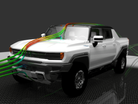
General Motors (GM), the American automotive giant, is ramping up its focus on a virtual-first methodology, leveraging AI to accelerate the vehicle development cycle.
GM is presently developing a concurrent manufacturing framework that allows a broader range of team members to collaborate within a unified digital environment. Through this shared foundation, specialists in design, aerodynamics, software, controls, safety and manufacturing can simultaneously apply integrated practices to the development process.
Redefining manufacturing
By leveraging XR technology, GM bridges the gap between digital CAD models and physical reality. Teams at GM can now virtually review assembly sequences, evaluate design iterations and identify ergonomic concerns without the need for physical prototypes or 3D-printed hardware for validation. This virtual-first approach enables equipment to operate in a digital space, allows maintenance and operations staff to participate in early reviews and enhances safety assessments. Furthermore, augmented reality (AR) is used to overlay digital equipment onto physical facilities.
Engineers can use this method to confirm the placement, spacing and accessibility of production tools before they are physically installed.

Importance of AI and virtual reality
To improve efficiency, GM is shifting from sequential handoffs to a synchronous engineering model. By integrating AI into various workflows, the company utilises the technology to process initial sketches and concepts while keeping human operators in control. As a developmental tool, AI facilitates broader design-space exploration, allowing for more variations, faster feedback and effective task delegation.
Additionally, GM employs an AI-powered virtual wind tunnel for real-time aerodynamic evaluations of surface modifications, as well as closed-loop simulation models that connect physics-based plant models with virtual controllers.
Through the application of sophisticated machine learning and simulation, GM has dramatically reduced the time required for roof crush analysis. What previously took between 8 and 40 hours can now be completed in under five minutes, allowing engineers to explore significantly more iterations and complex edge cases prior to the commencement of expensive physical validation.
GM’s innovative efforts
GM recently announced the plans to manufacture sodium-ion batteries at the company’s Wallace Battery Cell Innovation Center in Warren, Michigan.
Developed in collaboration with Peak Energy, these batteries function similarly to lithium-ion versions because of their comparable architecture, using the movement of ions to store and discharge energy.
Kurt Kelty, VP of Battery and Sustainability at General Motors, says: “At GM, we know that the application should determine the battery and for grid-scale stationary storage, sodium-ion is the right solution.
“Peak is already demonstrating the value of sodium-ion through their innovative energy storage platform, and together we're working to push those benefits even further with our next-generation cell — helping deliver more reliable, lower-cost energy storage at scale for the US grid.”
GM is managing the integration of 10,000 batteries into energy infrastructure. The company additionally intends to implement second-life batteries at a different Michigan facility. At this location, approximately 100 packs are anticipated to deliver 7.2MWh of transmittable energy and generate more than US$3m in local electricity.
While navigating logistical changes and ongoing tariff difficulties, GM has prioritised the production of electric vehicles through 2026. As part of a major transition to reach carbon neutrality by 2040, the company has set an ambitious goal to replace all gasoline and diesel engines with a fully electric vehicle range.
Company portals

Executives

Kurt Kelty
Vice President, Battery, Propulsion, and Sustainability, General Motors