
Hanwha’s Qcells Begins Solar Cell Manufacturing in the US
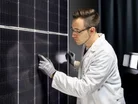
Qcells, which was bought by South Korean business conglomerate Hanwha in 2012, announced that it has begun manufacturing solar cells at its Cartersville, Georgia factory.
Solar is currently ramping up in the US. Energy thinktank Ember said on 10 June 2026 that solar had overtaken coal in US energy production in May for the first time, in a milestone for clean power generation.
Solar supplied a record 12.8% of US electricity in May 2026, while coal fell to 12.2%, its fourth-lowest monthly share, despite US President Donald Trump’s push towards coal as an energy source.

Qcells' solar cell production
Qcells' site in Georgia has begun production of solar cells, which the company calls a major milestone toward completing the country’s only vertically integrated solar manufacturing plant.
Hanwha expects cell production to scale fast. By Q3 2026, Cartersville will make 3.3GW each of ingots, wafers, cells and 3.5GW of modules a year, the company says.
At full production, this would make the site the largest solar cell factory in US history.
In addition to starting its cell production, Cartersville module assembly is now at full capacity, building 16,700 panels per day.
Andy Park, Global CEO of Qcells, says: “Producing the first solar cells at Cartersville is a milestone for Qcells and for American manufacturing.
“As our ingot, wafer and cell lines reach full capacity, we’ll be making the major components of a solar panel right here in Georgia.
"A dependable domestic supply chain doesn’t just create thousands of good-paying jobs, it gives our customers greater certainty on price, supply and tariffs, and a product they can trust from start to finish.”
Production in Georgia
Qcells was initially founded in Germany and is now headquartered in Seoul, South Korea, where its parent company Hanwha is headquartered.
It began work in Georgia on its facilities in 2019, when its site in Dalton opened.
Combining the Cartersville factory together with the Dalton factory which tripled module capacity to 5.1GW in late 2023, Qcells estimates its total module capacity in Georgia will reach 8.6GW a year, or 47,000 panels a day. This is roughly the energy needed to power roughly 1.3 million US homes for a year.
Together with the expanded Dalton campus, Qcells’ Georgia operations are expected to employ nearly 4,000 people, an estimated 3,800 direct jobs.
Solar power and the US Government
While solar overtook coal generation for the first time in May 2026, the industry still faces an uphill battle.
US President Donald Trump has been highly critical of solar power, heavily favouring coal and fossil fuels and has been actively seeking to dismantle tax credits related to them.
In an Executive Order titled “ENDING MARKET DISTORTING SUBSIDIES FOR UNRELIABLE, FOREIGN CONTROLLED ENERGY SOURCES” President Trump's administration wrote: “For too long, the Federal Government has forced American taxpayers to subsidise expensive and unreliable energy sources like wind and solar.
“Moreover, reliance on so-called 'green' subsidies threatens national security by making the United States dependent on supply chains controlled by foreign adversaries.”
Qcells' supply chains and tax credits
Because the South Korean solar manufacturer is manufacturing entirely domestically, it is able to capitalise tax credits. Qcell's domestic manufacturing footprint positions it to capture the full value of the Section 45X Advanced Manufacturing Production Tax Credit across the solar value chain.
By producing ingots, wafers, cells and modules domestically, the company can claim credits at each stage of production, something no other US solar manufacturer can currently do. It does not appear that Qcells has been hit by President Trump sweeping reforms to clean energy incentives.
Additionally, Qcells says its fully integrated manufacturing platform helps shield customers from supply chain disruptions and trade uncertainty; by producing major solar components domestically, the company reduces exposure to international supply constraints and tariff volatility.

Executives

Park Andy (Seungdeok)
Chief Strategy Officer (CSO)