How BMW is Using Figure AI Humanoid Robots in Production
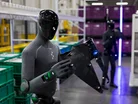
German carmaker BMW has demonstrated the Figure 03 humanoid robot, developed by technology company Figure AI, at its Spartanburg manufacturing site in South Carolina, US.
BMW employs more than 11,000 people at its 10-million-square-foot production facility, where it assembles the BMW X3, X5, X6, X7 and XM Sports Activity Vehicles and Coupes.
As humanoid robots rapidly advance from a concept to reality, projections for the humanoid robotics market by 2030 range from under one million annual units to more than six million, according to data from the Boston Consulting Group.

Humanoid robots on the production line
The Figure 03 robot can switch between precise picking, the placement of thin-walled, individual parts and forceful manipulation - requiring whole-body coordination, including the ability to pull a large metal cart down the line.
Figure AI’s pixels-to-actions vision-language-action model, Helix 02, coordinates Figure 03’s hands, arms, torso and feet, allowing the robot to manipulate parts while stepping and repositioning its body to pull a heavy cart on caster wheels.
BMW says the use of humanoid robots is part of its broader strategy to expand its automation portfolio with physical AI.
Ulrich Wieland, Vice President of Production Control and Logistics, BMW Manufacturing, says: “Plant Spartanburg is the birthplace of humanoid robotics in BMW Manufacturing’s operational day-to-day activities.
“Having already successfully completed a pilot with Figure 02 in our body shop, we are now looking forward to deploying Figure 03 for a sequencing use case in logistics.”
Building on earlier BMW deployment
BMW is building on a deployment of the Figure 02 robot at its Spartanburg plant.
The further-developed successor, Figure 03, will now start at Spartanburg, working on complex sequencing applications in logistics.
Brett Adcock, Founder & CEO of Figure AI, says: “Our 11-month deployment of Figure 02 proved that humanoids are no longer lab experiments - they can be a valuable asset in establishing a flexible, reliable manufacturing workforce.
“We are excited to continue our work in Spartanburg as Figure tackles the complexity of the assembly and logistics hall.”
In collaboration with the technology company Figure AI, the Figure 02 robot supported the production of more than 30,000 BMW X3 vehicles over ten months.
In the body shop, the Figure 02 robot inserted sheet-metal parts for the welding process - a task that demands high speed and accuracy and can be physically demanding.
Humanoid robots in manufacturing
Humanoid robots are slated to revolutionise the way the manufacturing industry works. Venture capital funding for robotics surged more than threefold between 2023 and 2025, when it reached US$40.7bn annually, according to data from McKinsey.
As global deployments ramp up, the consulting firm argues that the strategic question is no longer whether humanoid robots will work but whether they can scale economically and at what cost, speed and reliability.
China is currently ahead on robotics installations, compared to all other countries. Data from the International Federation of Robotics (IFR) shows that China recorded a world record of 2,027,000 industrial robots working in factories and its annual installations hit 295,000 units in 2024.
A total of 45% of the global installations of robots in the automotive industry took place in China in 2024, according to the IFR’s data.


Executives
Brett Adcock
Founder

Ulrich Wieland
Vice President of Steering Production, Production Systems and Logistics