How Rolls-Royce is 3D Printing Aircraft Engine Components
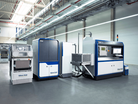
Rolls-Royce has opened a new Additive Manufacturing (AM) Development Cell at its Defence Assembly and Operations facility in Bristol, UK.
With funding from the UK Ministry of Defence, the cell uses AM technology to manufacture components for aircraft engines.
McKinsey’s analysis of the AM sector shows it has grown to a US$15.67bn industry with a 22% annual growth rate.

Rolls-Royce’s manufacturing cell
Rolls-Royce says the cell uses advanced AM technology to manufacture critical components for next-generation aircraft engines.
The cell is housed in a custom-built, carefully controlled 350 m² space. The humidity, temperature and air pressure are optimised to ensure consistent quality.
The AM machinery creates aerospace components layer by layer using metal super-alloy powders, intricately melting powder using laser beams.
Rolls-Royce says the machinery will play a critical role in accelerating innovation, knowledge and skills across the Global Combat Air Programme (GCAP) and future combat power and propulsion across Defence and wider Rolls-Royce applications.
Andy Higginson, Senior Vice President of Manufacturing, Assembly and Test at Rolls-Royce, says: “Across Rolls-Royce we are committed to the continued development and enhancement of our technologies to meet the demands of today, while providing scalable infrastructure required for the future.
“Programmes like FCAS and GCAP will be fundamental to the UK’s future aerospace sector and capabilities like additive manufacturing will be crucial to enabling innovation at pace, driving cost savings and enhancing the skills and capabilities of our people.”
Rolls-Royce says that it uses German-engineered technology. The company has previously purchased multiple Nikon SLM500 machines for manufacturing aero-engine parts.
Sam O'Leary, CEO of Nikon SLM Solutions, wrote in a post on LinkedIn: "Very proud of our technology being deployed here, and of course our partnership with Rolls Royce."
The Bristol hub
Engineers are being specially trained to use the cell at Rolls-Royce’s site in Bristol.
The company says that advancement in technology will help to sustain and create jobs at the hub.
Luke Pollard MP, Minister for Defence Readiness and Industry, says: “This new facility in Bristol is a clear sign of UK industry investing in the skills and technology we need to stay ahead.
“By using the latest manufacturing techniques to build lighter, more efficient components, Rolls-Royce is helping to keep British engineers at the forefront of innovation, all the while creating and sustaining skilled jobs right here in Bristol."
The company argues that by integrating the technology, UK capability remains at the cutting-edge of aerospace engineering, manufacturing complex parts with reduced lead time, reduced cost and increased efficiency compared to traditional methods.
UK defence spending and AM
According to the UK Government, the country's defence spending is expected to total £62.2bn (US$83.9bn) in 2025/26, increasing to £73.5bn (US$99.15bn) in 2028/29. This is equivalent to an annual average real-terms growth rate of 3.8% over this period.
European NATO countries are increasing defence spending significantly, with McKinsey’s projections estimating up to €1tn (US$1.17tn) by 2030.
Some of this heightened defence spending from UK and European powers may go towards new technology and growing industrial techniques such as AM. Rolls-Royce's cell in Bristol received funding from the UK Ministry of Defence.