
Inside Lush’s Conscious Creations
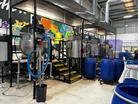
Lush has championed ethical, handmade cosmetics since its founding in 1995, with sustainability at the heart of its operations. Known for pioneering packaging-free products and responsible ingredient sourcing, the company continues to set industry standards. Among its standout innovations is the bath bomb, invented by Co-Founder Mo Constantine in 1989, which remains a global bestseller. In the past year alone, Lush has sold more than 40.5 million bath bombs, all handmade in its own factories.
Visiting Lush’s manufacturing hub in Poole last December revealed to me how deeply sustainability is embedded in its production process. From ingredient sourcing to energy use, every step is designed to minimise environmental impact. Lush’s approach offers a blueprint for businesses looking to balance ethics with growth.
A commitment to sustainable operations
One of the most fascinating parts of the visit was learning about Lush’s sustainability efforts. These are driven by key figures including Jack Gale, Utilities Lead for the UK and Ireland, and Chase Clark, one of the company’s Manufacturing Directors.
Jack, who has been with Lush for 12 years, manages utilities, emissions and efficiency projects across the company’s UK properties. He is part of Lush’s earth care team, which ensures sustainability across the Poole estate and retail stores.
Jack loves Lush’s shower gels, saying “I think the amount of bubbles that you get from a shower gel is just insane.” He particularly loves the Dirty range, which he explained was popular among his hairdresser friends.
Chase has spent 22 years at Lush and oversees seven global manufacturing sites, along with 12 ‘Fresh’ kitchens where products are made in small batches. His role extends to Lush’s property portfolio, fragrance department and the Green Hub, where waste is repurposed.
Chase’s favorite Lush product is Repeat, a moisturising foot balm which has refreshing and toning components: “It smells great and makes my feet soft.”
“Ultimately, it’s having that responsibility of making sure that we can supply handmade fresh products throughout our supply chain, through our digital fulfilment and our retail stores,” Chase explained.
Reducing emissions and maximising efficiency
A key focus for Lush is reducing its environmental impact, particularly its Scope 3 emissions—those generated throughout the supply chain. Jack highlighted their significance: “Supply chain is, in terms of emissions and impact for the business, about 94% of the overall challenge for us to tackle.”
To address this, Lush has partnered with Ecotricity since 2008 to supply 100% renewable energy in the UK. This commitment extends worldwide, ensuring that even in markets with limited supplier choice, Lush prioritises renewable energy accreditation.
Lush’s net zero strategy also focuses on property selection. “Getting that choice right at the start makes the journey towards net zero a lot easier,” Jack added. Moving away from natural gas and diesel for transport is one of the biggest hurdles, with a target set for 2030. “I think that’s a very difficult target for anyone to achieve,” he admitted.
Jack also stressed the need for improved grid infrastructure to support Lush’s sustainability goals. Its Poole site, though efficient, requires significant investment to fully transition away from fossil fuels. Reflecting on the company’s progress, he noted: “I think it is important sometimes to look back at all the good work done in the past before it started to become compulsory to report on these kinds of things.”
Handmade innovation and ethical growth
As we explored the different departments within Lush’s Poole site, it became clear that at each stage sustainability is woven into Lush’s operations, from packaging-free products to waste management.
Chase explained how this approach shapes product development: “We’ve obviously talked about the sourcing and the supply chain, we’ve talked about the property and the processes that we have, but I think it’s also to add into that actually our products.”
Lush’s commitment to “naked” products—those without packaging—reduces plastic waste while maintaining product integrity. Handmade production ensures every bath bomb, soap or shampoo bar has a personal touch. “We like there to be a personal touch and I think the handmade value is definitely in the fact that when you look at a bath bomb each one will have its own touch, it will look a little bit different,” Chase explained.
The company also takes waste management seriously. Each year, Lush recycles nearly 2,000 tonnes of waste from its Poole manufacturing operations, with 52% consisting of solid materials such as plastic, cardboard and metals. “Off that 52%, 68% we would consider to be fully recycled,” Jack said. Wastewater remains the biggest expense, costing approximately £340,000 annually to process, though rebates for recycled materials total around £55,000. Lush aims to close the loop entirely, ensuring that waste is either reused or eliminated.
Scaling up production sustainably presents challenges. Seasonal demand requires Lush to double its workforce during peak periods while maintaining quality and ethical standards. To reduce emissions, the company aims to ship 80% of goods by sea. At its Green Hub, production waste is composted, showing that sustainability can be achieved through practical, low-impact solutions.
Chase acknowledged the difficulty of maintaining Lush’s sustainability standards while expanding globally. Different climates affect manufacturing, requiring product adjustments. “Whilst we’ve been around for close to 30 odd years, I think our products are quite susceptible to different changes in climate humidity,” he said, explaining that formulas often need to be adapted for regions such as Toronto and Sydney.
During my visit, it became clear that Lush’s success is built on collaboration and a shared mission to innovate responsibly. Sustainability isn’t an afterthought—it is at the core of everything they do. As Chase summed up: “We apply that approach into everything that we do and want our staff to feel like they are a part of something, as well as our customers being able to connect in that way to what we do as a business.”
Lush’s products go beyond beauty, they’re part of a commitment to “leave the world lusher than we found it.”
To read the full article in the magazine, click HERE.
Explore the latest edition of Sustainability Magazine and be part of the conversation at our global conference series, Sustainability LIVE.
Discover all our upcoming events and secure your tickets today.
Sustainability Magazine is a BizClik brand