Kinaxis: Turning Supply Chain Data into Decisive Action
Distributed manufacturing networks, geopolitical volatility and shifting consumer demand are forcing companies to rethink how they plan, act and adapt.
For Kinaxis, the answer to this complexity combines two distinct forms of AI with a modern, unified data foundation.
Andrew Bell, Chief Product Officer at Kinaxis, says that AI is a spectrum of capabilities, each with a distinct role.
“When we talk about AI, we should not think of it as just one thing,” he explains.
Two types of AI, one unified purpose
Kinaxis distinguishes between predictive AI, encompassing machine learning, mathematical optimisation and deep modelling, and agentic AI, which is changing how decisions are made.
Predictive AI processes huge volumes of internal and external data to generate the most optimal supply chain plan.
Agentic AI drives three distinct outcomes:
- Productivity through autonomous decision-making
- Democratisation of access for non-technical business leaders
- Composability of end-to-end workflows that were previously created by human effort.
Together, these two capabilities allow supply chain teams to move from generating insights to taking real-time action.
The data problem for AI
Before AI can deliver on these promises, it needs a strong data foundation.
Andrew explains: “Planners spend the vast majority of their time pulling data together, not making decisions.”
When that data is contradictory, latent or incomplete, the resulting decisions are flawed regardless of the intelligence applied to them.
Physical supply chains are also becoming more complex.
Nearshoring, offshoring and hybrid transportation strategies mean more data points, more variables and a greater need for real-time visibility.
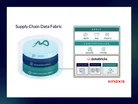
The Kinaxis data fabric, augmented by Databricks, supports the Maestro platform, unifying internal enterprise data with outside-in signals covering demand forecasting, geopolitical risk, transport availability and material supply.
Governing AI in high-stakes environments
Supply chains are not the place for unmitigated risk.
A wrong decision can mean failing to meet customer demand, misusing network capacity or producing the wrong goods entirely
“The implications are massive,” Andrew says. “They are measured in the millions and billions.”
That is why Kinaxis takes a human-in-the-loop approach to AI governance.
Decisions must run against a governed, accurate and up-to-date data model.
Human oversight sets the conditions and policies within which AI operates, ensuring that autonomous actions remain aligned with business objectives.
Trusted data lineage is just as essential.
Every decision made by the system must be traceable, enabling continuous learning and improvement over time.
Autonomous operations
Kinaxis is now entering what Andrew describes as an “extremely exciting” period.
Its foundational architecture work is beginning to pay off, leveraging the Kinaxis data fabric and its integration with Databricks, along with the agentic framework and the scenario simulation capabilities of Maestro.
“What you are going to see over the next 12 months is more autonomous operations, more agentic capabilities,” Andrew says.
Maestro is evolving into a composable layer on which unique, high-value solutions can be built, moving customers away from siloed discrete systems and towards a single, unified orchestration model.
The goal is not AI for its own sake.
Andrew explains that enterprise partnerships, technology choices and platform decisions must all serve one purpose: helping customers make the best possible decision, at the speed of business.
Company portals

Executives
Andrew Bell
Chief Product Officer