
The Manufacturer Making the World Lusher Than They Found It
Many companies claim to be different. They label themselves as trailblazers, or ecowarriors, or disruptors. ‘People are at the heart of everything we do’ reads the website, ‘we’re not a blank company, we’re a blank company’ reads the blurb.
Few in actuality meaningfully diverge in their approach to manufacturing, culture and the supply chain. In today’s oversaturated product landscape, differentiation is marketable currency- but few are prepared to commit to the real thing.
Today isn’t about these companies. Today is about Lush, a company whose promises have meaning. Visiting its factory in Poole, Manufacturing Digital witnessed a manufacturing process that is undoubtedly different.
Here’s our breakdown of what set it apart, as we welcome you to the lush life.
Circularity: at Lush’s core
It’s impossible to discuss Lush’s manufacturing strategy without discussing circularity.
It’s integral to everything they do, from its twelve fresh kitchens across the globe to its myriad of sustainable sourcing and biodiversity projects.
“It really starts with our supplier selection,” says Gabbi Loedolff, Director of Buying at Lush.
“When we think about our mission of leaving the world lusher than we found it, there are three ways we’re doing this across our supply chain.
“Firstly we design products from scratch, with all our regenerative principles, but this takes a lot of time and resources.
“Secondly we find amazing suppliers that are already aligned and restoring ecosystems and being part of local value addition and bring them into our supply chain.
“So thirdly our biggest approach is working with our existing supply base, working to understand them through third party assessments and questionnaires, going out and seeing first hand what they do. So together we share expertise that can make our process more sustainable.”
Reducing waste, including in terms of energy is a critical consideration overall for lush according to Jack Gale, Utilities Lead at Lush.
“With our products we’re telling a story,” he says. “How we deal with the waste that comes through from our manufacturing process is part of that story. We want to ensure we’re taking responsibility.”
Jack highlights Lush’s bring it back scheme, which enables customers to return all of Lush’s fully recycled packaging, creating a closed-loop process.
Acknowledging that the majority of their waste is generated as a by-product of their manufacturing process, Jack emphasises that it's important this isn’t just: “put on to third-party vendors and pushed out of sight out of mind.”
- Just under 2,000 tonnes of waste recycling- handled by Lush- from Poole manufacturing operations
- 52%- sold materials including plastic, cardboard & metals
- 68% of this 52%- can be fully recycled
- Remaining 48%- water waste, a byproduct of wet production processes
- £340,000 ( US$425,000)- spent per annum to process, transport and dispose of- 2,000 tonnes of waste
- £55,000 ( US$68,750)- rebate Lush receives for these materials
“Instead, we're finding ways we can not just recycle and reuse but also reduce our actual wastage,” Jack adds.
“Whether it's through energy or whether it's from the tangible waste that we generate. This work is one of the big drivers of the Green Hub.”
Lush’s Green Hub is the physical representation of its commitment to the circular economy. First opened in 2015 it has since grown into a dedicated operation, dedicated to researching and trialing new approaches to becoming more ecologically and environmentally responsible.
Lush’s commitments to sustainability are also part of its commitment to quality. Its array of bath bombs, shower jellies and superpowered smellies use all-natural, vegan ingredients that sing on the skin and smell good.
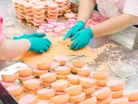
A key dimension of this commitment to quality is Lush’s commitment to handmade products, bucking the trend of widespread factory automation.
A belief in the value of handmade
Something that stands out about Lush is its belief in its handmade, people-led process.
With the rise of industry 4.0 and growing importance of sustainability, mass factory automation is treated as an inevitability for manufacturers, a necessary investment to boost productivity and lower costs.
The subsequent job losses at Port Talbot, at Stellantis’s Luton EV plant, and at many other factories- are treated as an unfortunate inevitability too. An unpleasant symptom of progress.
Lush disrupts this assumption.
“We’ve been able to release and launch at double the speed because we retain this element of being so handmade,” says Chase Clark, Manufacturing Director at Lush.
“The fact we’re so tactile means we can take a product from concept, invention, development, to mass-scale production, and then out to stores in very, very quick time.
“This means we can iterate as we go. We very much use this agility to our advantage when creating products.”
This has been a boon during Lush’s rapid expansion and the newfound virality of many of its products.
“Social media virality of products like Dream Cream, Sleepy, Supermilk, and Sticky Dates has been both a challenge and an opportunity,” says Chase.
“Meeting increased demand requires quick adjustments in production, sourcing materials amidst supply chain disruptions, and maintaining ethical and environmental standards, such as prioritising ocean freight over air.”
This challenge has been intensified by the growth in Lush’s media tie-ins. From Barbie to Wicked to the Super Mario movie, products appear in store to match. Products which should feel personal and unique.
“We don't like our products to be too cookie-cutter or uniform, we like there to be a personal touch,” says Chase.
“I think the handmade value is definitely that. We have a spec in terms of quality, but when it comes to how those products look, it’s important people are connected with those products for each step.”
Part of this connection is Lush’s iconic face stickers, which let buyers know who has made each product. We saw real proof that this is no sneaky marketing ploy, but a sincere gesture to acknowledge the labour that goes into every bubble bar and perfume.
All this is not to say that Lush isn’t exploring digitalisation. In the factory we saw how the company is using additive manufacturing to create initial prototypes, saving costs, and resources during the design phase.
“We are always evaluating our process internally and looking at the technology of other manufacturers, whether it's a machinery process element or whether it's systems or software,” Chase adds.
“Under Cosmetic Warriors and the R&D umbrella of the business, we have separate teams evaluating where we can push innovation.”
Chase notes that digitalisation may be a means for Lush - as it is for many manufacturers - to navigate the current hiring crisis. Hiring is an important priority for a company shaped by seasonal demand spikes.
Still, Lush doesn’t treat automation as a means to replace the labour people can do.
“There is definitely a way for us to bring technology and potential automation or semi-automation, but rather than see it as replacing people, it's very much to work hand in hand with what we do,” says Chase.
“It needs to support the business and its growth whilst retaining the handmade value that goes into the product.”
For Lush, technological adoption must be strategic and purposeful. There is no rushing to implement the latest in automation or AI if it doesn’t benefit staff or the business. Chase told us Lush has been burned in the past by this mindset, learning a valuable lesson.
That lesson is that Lush’s competitiveness lies in its ability to walk a very different path- rather than outpace those racing on the same road.
Its self-assuredness in its approach, comes from knowing it's doing the right thing.
“Meeting increased demand requires quick adjustments in production, sourcing materials amidst supply chain disruptions, and maintaining ethical and environmental standards, such as prioritising ocean freight over air.”
This challenge has been intensified by the growth in Lush’s media tie-ins. From Barbie to Wicked to the Super Mario movie, products appear in store to match. Products which should feel personal and unique.
“We don't like our products to be too cookie-cutter or uniform, we like there to be a personal touch,” says Chase.
“I think the handmade value is definitely that. We have a spec in terms of quality, but when it comes to how those products look, it’s important people are connected with those products for each step.”
Part of this connection is Lush’s iconic face stickers, which let buyers know who has made each product. We saw real proof that this is no sneaky marketing ploy, but a sincere gesture to acknowledge the labour that goes into every bubble bar and perfume.
All this is not to say that Lush isn’t exploring digitalisation. In the factory we saw how the company is using additive manufacturing to create initial prototypes, saving costs, and resources during the design phase.
“We are always evaluating our process internally and looking at the technology of other manufacturers, whether it's a machinery process element or whether it's systems or software,” Chase adds.
“Under Cosmetic Warriors and the R&D umbrella of the business, we have separate teams evaluating where we can push innovation.”
Chase notes that digitalisation may be a means for Lush - as it is for many manufacturers - to navigate the current hiring crisis. Hiring is an important priority for a company shaped by seasonal demand spikes.
Still, Lush doesn’t treat automation as a means to replace the labour people can do.
“There is definitely a way for us to bring technology and potential automation or semi-automation, but rather than see it as replacing people, it's very much to work hand in hand with what we do,” says Chase.
“It needs to support the business and its growth whilst retaining the handmade value that goes into the product.”
For Lush, technological adoption must be strategic and purposeful. There is no rushing to implement the latest in automation or AI if it doesn’t benefit staff or the business. Chase told us Lush has been burned in the past by this mindset, learning a valuable lesson.
That lesson is that Lush’s competitiveness lies in its ability to walk a very different path- rather than outpace those racing on the same road.
Its self-assuredness in its approach, comes from knowing it's doing the right thing.
To read the full article in the magazine, click HERE.
Explore the latest edition of Manufacturing Digital and be part of the conversation at our global conference series, Manufacturing LIVE.
Discover all our upcoming events and secure your tickets today.
Manufacturing Digital is a BizClik brand.