Unilever's Chicago Plant: A True Factory of the Frontline
Investing in digital transformation is an absolute imperative for manufacturers today - but so is understanding how to leverage those technologies to attract and retain staff.
The hiring gap in manufacturing continues to widen across nations, with a study by Deloitte and the Manufacturing Institute conducted in late 2024 demonstrating that 1.9 million manufacturing jobs may go unfilled this year in the US alone.
Technologies like automation and AI were once situated as means to bridge or manage this crisis.
But they have also created the need for specialised new roles focused on digital skills that manufacturers are also struggling to fill.
The root causes and factors shaping the hiring gap in manufacturing are complex, and require years of extensive cross-industry and educational collaboration to address.
One factor that must be included within this according to the World Economic Forum and McKinsey is manufacturers' own perspective on the workforce.
In their latest collaborative whitepaper 'Putting Talent at the Centre: An Evolving Imperative for Manufacturing' the organisations argue manufacturers need to shift their perspective, seeing their workforce during an increasingly challenging time for hiring and retraining as an investment.
"Technology isn’t at the heart of production. People are," explains Kiva Allgood, Head, Centre for Advanced Manufacturing and Supply Chains, World Economic Forum.
"Putting people at the center is not a new idea, but technology has undeniably transformed industry and continues to do so, which means this imperative is evolving – and so must our playbook for meeting it.
"Currently, a gap exists between business ambitions and the frontline talent needed to achieve those aims.
"By 2030, 54% of the workforce in the advanced manufacturing sector will require training to meet evolving skill demands.
"As former leaders in production, we’ve heard “people first” countless times. Yet, we know how challenging it is to turn that slogan into reality – especially in manufacturing and supply chains."
Fernando Perez, Senior Partner and Leader, the Frontline Workforce of the Future Service Line, McKinsey & Company agrees, adding that:
"A McKinsey study shows that companies with effective people strategies are 2.2 times more likely to outperform their peers.
"Yet many still treat talent as a cost rather than an investment. It’s time to shift to a perspective that views frontline workers as key drivers of stability, productivity and growth.
"Organisations that embrace this mindset – offering not just fair wages but opportunities for development and connection – will lead the future of production."
Introducing the 'Frontline of the Future'
To foster this shift in perspective, the organisations have created the 'Frontline of the Future Initiative' - a play on the 'factory of the future' - which explores how investing in talent innovation creates win-win scenarios for manufacturers.
So far 13 sites have participated in the initiative's pilot from ten countries, with eight sites being visited in person.
These included Haeir's plant in China, a leading Saudi Aramco site in Saudi and a Schneider Electric factory in India.
Of these sites, WEF and McKinsey & Co identified 61 talent innovations.

The manufacturer most recognised however was Unilever, highlighted seven times for innovations it has deployed at plants across the world, from Brazil to Chicago, USA.
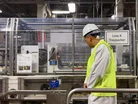
Focusing specifically on Unilever's Chicago facility, we see a true 'factory of the frontline', where digital innovations are being harnessed to enhance employee upskilling, efficiency, satisfaction and retainment.
As part of the Frontline of the Future Initiative, this site has successfully implemented changes that have led to substantial improvements in absenteeism, employee retention and overall equipment effectiveness (OEE).
Transforming workforce structure for agility
Operating in a competitive talent market, Unilever Kilbourn recognised the need for a more flexible and dynamic approach to workforce management.
The site introduced a system that systematically reviews and revises its organisational structure every six months.
This process ensures that roles remain aligned with business needs and the available talent pool, creating ongoing development opportunities for employees.
As a result, 81% of local management positions have been filled through internal promotions, significantly reducing attrition by 68%.
By prioritising career growth and flexibility, the factory has established a culture where employees see clear pathways for advancement, fostering long-term commitment and stability within the workforce.

Leveraging technology for workforce development
A key innovation at the Kilbourn site is the introduction of a transparent and flexible scheduling app.
This tool allows employees to have greater control over their work schedules, addressing a critical area of employee feedback.
By providing this flexibility, the site has improved work-life balance and job satisfaction, contributing to better retention rates.
In addition, Kilbourn has embraced an “always-on” Gemba philosophy, ensuring continuous dialogue between leadership and frontline workers.
This approach fosters a culture of openness and collaboration, where employees feel heard and valued, further strengthening engagement and productivity.
Leveraging gamification for employee engagement
To further enhance motivation and productivity, Unilever Kilbourn implemented a creative, performance-based rewards system.
This gamified programme operates on a monthly point system that complies with collective bargaining agreements, rewarding employees for achieving common site goals, shift targets and individual performance metrics.
Accumulated points can be redeemed for gift cards, providing tangible incentives for strong performance.
Bi-weekly town halls have also been introduced, where site leadership shares performance updates and recognises top-performing shifts.
These gatherings encourage friendly competition and serve as a platform for employees to contribute improvement ideas. This initiative has played a crucial role in fostering innovation and maintaining high levels of employee engagement.
Achieving measurable success
The impact of these workforce innovations at Unilever Kilbourn has been significant.
Absenteeism has improved by 48%, while OEE has increased by 16%.
Product waste has decreased by 34%, and revenue per employee has risen by 36%. Additionally, employee engagement has surged by 26%, reflecting the success of the factory’s people-centric approach.
By embracing strategic talent management, flexible scheduling and a robust recognition system, Unilever’s Kilbourn factory is setting a new benchmark for workforce development.
These efforts not only enhance employee satisfaction but also drive operational excellence, ensuring long-term sustainability in an evolving industrial landscape.
"While we’re making great advancements in digital and technology in manufacturing, it's the incredible people behind these innovations that truly drive our success," wrote Willem Uijen, Chief Supply Chain and Operations Officer, Unilever on LinkedIn.
"Congratulations to Nickolas Ernst and the Unilever Kilbourn, Chicago team for being recognised by the World Economic Forum and McKinsey & Company as a standout 'Frontline Talent of the Future' factory.
"The people-focused digital transformation at Kilbourn is redefining process excellence and embracing empowerment to drive productivity growth.
"I had the pleasure to visit our Kilbourn site, Friday last week. The history of the site is amazing starting back in 1918, with some of the buildings still from that era.
"Now a site that is at the forefront of modern-day manufacturing, not just with assets, processes and systems, but most of all through its people.
"The energy, knowledge and drive of the factory team on the floor is outstanding. I look forward to what our Kilbourn site will achieve next!"
Explore the latest edition of Manufacturing Digital and be part of the conversation at our global conference series, Manufacturing LIVE.
Discover all our upcoming events and secure your tickets today.
Manufacturing Digital is a BizClik brand