
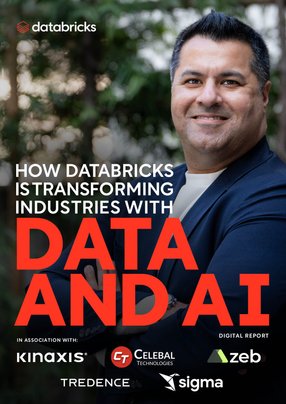
How Databricks is Transforming Industries with Data and AI
AI promises to transform industry but, for many businesses, the gap between ambition and reality remains stubbornly wide. Databricks, the data and AI company, believes it has the architecture to close it.
Founded with a mission to democratise data and AI, Databricks has grown into a platform trusted by more than 20,000 customers daily, including 70% of the Fortune 500. Its technology unifies structured and unstructured data under a single platform, then layers intelligence on top to make the data usable by ordinary business users.
Shiv Trisal, Global Industrials GTM Lead at Databricks, joined the organisation four years ago and has watched it grow from nimble startup to software giant.
However, he reveals something essential has stayed the same: “We still operate – even though we are at 10,000 to 12,000 people now – with the mentality that we were born yesterday. That day-one spirit is still alive here.”
What has changed is the scale of the ambition. As of February 2026, Databricks was valued at US$134bn and has surpassed a $5.4bn revenue run-rate, growing approximately 65% year over year – territory occupied by only a handful of technology companies.
“It’s rarefied air,” Shiv says, “but that’s where we are going.”
Breaking down walls between data systems
To get there, Databricks is pushing hard into a new category – lakebase architecture – and its product Databricks Lakebase Postgres. Understanding what that means requires a brief detour into how enterprise data has traditionally been managed.
For decades, businesses have operated two separate kinds of data systems. Analytical systems – used for insight and reporting – differ from operational systems, which handle transactions, orders and live workflows. Moving data between them has always meant creating copies, which quickly fall out of sync.
Shiv argues that this model is no longer fit for purpose, particularly as AI agents that can act autonomously begin to shoulder more of the work that people once did.
“That world of taking extracts from the analytical world into the operational world accepts that humans will be doing work on spreadsheets,” Shiv continues. “Agents, unfortunately, don't work like humans.”
Lakebase, as Databricks conceives it, dissolves the barrier between these two worlds. It allows predictive and generative AI outputs to be acted upon directly within live operational workflows, without the need for data extracts or manual intervention.
Shiv draws on his background in aerospace to illustrate the point. When working on aircraft predictive maintenance, his team could identify a likely failure in advance, but the next steps – checking parts availability and scheduling engineers – required querying entirely separate systems.
He adds: “That part has become a lot easier now with Lakebase, versus having to manage the multiple data extracts from business systems.”
A new database for the agent era
The case for Lakebase is also a case against the status quo. Traditional transactional databases, Shiv argues, have seen little fundamental innovation since the 1980s. They were designed for human users working at human pace. AI agents operate very differently.
“Agents acting on behalf of humans will be spinning up databases at a speed and scale that we have never seen before,” Shiv asserts. Databricks has invested in and acquired specific technologies to support this, which the current transactional database market simply cannot match.
The practical implications are significant across several industries. In automotive, for example, manufacturers managing tens of thousands of parts across multiple vehicle models must constantly reconcile their bill of materials with live risk data.
Shiv explains: “The whole aspect of managing the most up-to-date parts list for every vehicle, every model that you've shipped, in a way that helps you serve the fleet better and manage your recall or warranty risks – that's a very good application of what Lakebase can do.”
The architectural shift also has implications for how companies think about AI investment more broadly. Every business now has access to the same frontier models. What differentiates one company from another is the data it holds and how well it can use it.
“Most of the interesting datasets in the world are not sitting on the internet,” Shiv elaborates. “They're sitting behind firewalls of companies.
“What are the unique datasets? What are the distribution advantages that you have and how do you operationalise that? That is the essence of data intelligence.”
Genie: Bringing data to the business user
Databricks' most visible expression of data intelligence is Genie. The product is, at its core, an agentic AI system that allows business users to query enterprise data in plain language and get insights without writing a single line of code.
A user at an energy company, for example, might ask why some of their container vessels transporting a particular product are not in an expected location. Rather than constructing complex database queries, they simply ask the question. Genie then creates a comprehensive multi-step plan and writes the code in the background, maps it to the company's curated data and returns an answer.
The system also improves over time through automatic knowledge extraction from usage data captured in the Databricks platform combined with human feedback. For example, users can instruct it on how to interpret company-specific terminology – defining, for instance, that ‘EMEA’ should be understood to mean Europe, Middle East and Africa. In other words, it learns the language of the business it serves.
Shiv uses Genie himself on a daily basis.
“For business users who don't write code, it is an exceptional capability,” he says. “I’m responsible for 3,000 customers at Databricks and I've replaced all my Excel sheets and 40 dashboards into one conversational interface.
“For people whose responsibilities do not include learning how to code, it's a great way to lower the barrier to entry.”
From factory floor to flight line
The applications of Genie that Databricks is seeing in manufacturing and supply chain are among the most compelling.
In supply chain planning, Genie is being used to enable top-down scenario analysis — something Shiv says most supply chain tools have historically failed to support.
He expands: “If you're a chip manufacturer and a major smartphone manufacturer reduces the forecast for the next phone, what is the impact? What am I selling less of? What does that mean for the capacity allocation I have at my fabrication facilities?
“That kind of analysis has been missing from most supply chain tools because they all optimise for procurement, for bottom-up demand forecasting, for logistics – but nobody's optimising the whole.”
For companies operating physical assets, such as rigs and wind turbines, the shift is equally significant. Executives in these environments do not want sensor-level alerts. Instead, they want to know whether there is a material risk to their operation, whether financial or safety-related. Genie allows them to ask exactly that.
A striking example comes from Joby Aviation, an electric air taxi developer and Databricks customer. Engineers at Joby use the platform to rapidly analyse flight test logs after every test, a process that directly governs how quickly the company can move to its next test and ultimately meet its Federal Aviation Administration certification timeline.
“The ability for AI and humans to quickly go through these test logs and close that process with an effective plan has been extremely successful," Shiv says.
The broader point concerns engineering productivity, with studies suggesting that engineers spend as little as 40% of their time on active engineering work. The rest goes on searching for data, navigating inadequate tools and correcting errors caused by missing information.
Shiv says: “How do we make these engineers – the most costly and most innovative resources inside these companies – more productive? That's an area I see a lot of promise in.”
Ecosystem built for scale
No technology platform succeeds in isolation. Databricks works with a broad partner ecosystem, from the major cloud providers – Amazon, Google and Microsoft – to industry-specific system integrators and software companies.
Among its partners are Zeb, an AI-native system integrator with deep expertise in logistics and energy; Celebal Technologies, which specialises in manufacturing and energy and works extensively with operational technology data from physical assets; and Tredence, which brings supply chain expertise at scale for some of the world's largest brands.
Meanwhile, Kinaxis, the supply chain planning software company, is integrating Databricks technology directly into its next-generation product. Shiv says: “They see the world very similarly to us – it's not just humans monitoring dashboards, it's humans and agents collaborating to achieve outcomes.”
Elsewhere, Sigma Computing, a business intelligence platform, enables low-code solutions built on top of Databricks data, giving users a familiar interface without the need to work with data extracts. The integration, Shiv notes, remains tight with the underlying Databricks platform throughout.
Making ‘real decisions’ with AI
Shiv is clear about what matters most over the next 12 months and beyond: moving AI from the strategy deck into production.
He asks: “How do we go from AI strategy being on a PowerPoint to being actually used in production, making real decisions alongside humans?
“That's really the goal and the shift we have to make as a company.”
For Databricks, the two organisational priorities are Genie's continued rollout to business users and the establishment of Lakebase as the foundation for human-agent collaboration. Underpinning both is a commitment to data governance – ensuring data from IT, operational technology and engineering sources is brought together under a single intelligence engine.
Shiv is candid about the wider challenge, insisting that too much has been promised and too little delivered in the physical world.
“Frontier models haven't really made much of an impact in the physical world," he says. “It starts with connecting machines, data and people, and embracing that in how you get work done.”
That, for Databricks, is precisely where the hard work begins.
Company portals

Executives

Shiv Trisal
Global Industrials GTM Lead