Planes to Missiles: How Lockheed Martin Uses 3D Printing
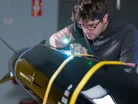
Lockheed Martin uses 3D printing to accelerate its production and reduce costs.
With some machines each the size of a truck, the company says additive manufacturing (AM) helps it to stay agile, dependable and responsive.
In Lockheed’s Grand Prairie, Texas, US facility, a 16,000 square foot expansion was made in 2024 to include some of the largest format multi-laser machines in the state alongside heat treatment and inspection equipment.
“We continue to invest in AM technology to provide value for our customers in a way that empowers our engineers to innovate and rapidly integrate new product designs and capabilities to the production floor,” says Tom Carrubba, VP of Production Operations at Lockheed Martin Missiles and Fire Control.
“This allows us to create affordable and modular designs that can simplify both high and low-volume production processes.”
Additive manufacturing
At its core, AM is the process of creating an object by building it one layer at a time.
While there are different types of AM, they usually follow the same digital-to-physical workflow that begins with a CAD file,
Software then slices that 3D model into hundreds or thousands of thin horizontal layers and a machine reads these slices and deposits material where needed for each layer.
Each layer fuses to the one below it using heat, light or chemicals.
Because material is added rather than cut away, AM can help to reduce the amount of raw material purchased for each finished product.
Traditionally, a complex part is expensive to make because it requires more tools, but using AM it roughly costs the same to print a solid cube as an intricate object.
It can also help to consolidate assembly that would usually require tens of different parts bolted or welded together.
The Advanced Manufacturing Technology Center
Lockheed’s Advanced Manufacturing Technology (AMT) Center opened in Texas in 2024.
This facility is designed to enable rapid development and deployment of manufacturing technology solutions and training for teams.
The company’s programme 1LMX aims to transform its end-to-end business processes and systems.
Additional work established an integrated environment with 1LMX tools to support expertise in design for AM and automation.
Tom said: “I am proud of the team for putting our vision into action.
“We have created a collaborative workspace to rapidly enhance our current production lines and to utilise our newer advanced manufacturing solutions early in our development programs.
“The excitement and energy our team has in making our Future Factory a reality is allowing us to meet the needs of our customer’s evolving challenges.”
Digital transformation
Lockheed’s F-35 Training & Logistics team delivered the first two 3D printed cockpits for the F-35 Full Mission Simulator in 2022.
The company says this can reduce the total lead time to obtain conventional parts by 75%.

The total part count of conventional metal parts is also reduced by 70%.
Lockheed says when its team began working on this project, the complex part had to be redesigned with a focus on manufacturability.
Digital twin technology was used to visualise the production floor and understand where these 3D printed cockpits can be inserted across the line.
Advanced planning was also needed to manage the flow of orders and deliver on time for customers as the time needed to produce the cockpit was reduced.
Long-range missiles
In 2020, Lockheed used 3D printing to help create a Precision Strike Missile.
The company says that three parts were printed for a US Army-tested missile which “performed flawlessly”.
In the test, the missile was fired and flew approximately 85 kilometres to the target area.
Printed parts are durable, provide flexibility and act as an extension of the company’s supply chain, allowing production teams to meet schedule requirements in the event of an issue.
Company portals

Executives
Tom Carrubba
Vice President of Production Operations - Missiles and Fire Control