Boston Dynamics: Hyundai's Plans for Humanoid AI Robots
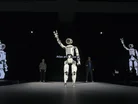
Hyundai Motor Group says it plans to accelerate its business with “cutting-edge” AI robotics across its manufacturing sites worldwide.
Atlas, a humanoid robot developed by Boston Dynamics, was shown off at the Consumer Electronics Show (CES) in Las Vegas, US.
Hyundai says it plans to use these robots in its factories from 2028 and establish a production system capable of manufacturing 30,000 robot units each year.
Boston Dynamics, of which Hyundai owns a majority stake, has partnered with Google DeepMind to accelerate the technological development of these robots.
Zachary Jackowski, Vice President and General Manager of Atlas at Boston Dynamics, says: “The convergence of robotics and AI represents more than a technological advancement. It is a transformative innovation that will make human life safer and more enriching.
“By combining capabilities of Boston Dynamics and Google DeepMind through this strategic partnership, we are taking a significant step toward redefining the future paradigm of the industry.”
Boston Dynamics’ Atlas robot
Atlas has 56 degrees of freedom, most with fully rotational joints, and human-scale hands with tactile sensing.
Hyundai says that the robot is able to perform precision tasks and lift up to 50 kg.
The company plans to introduce the robot on processes with proven safety and quality benefits from 2028, such as parts sequencing.

By 2030, the company expects Atlas’ applications to extend to component assembly and tasks involving repetitive motions and heavy loads.
Hyundai’s AI robotics strategy
Hyundai is building a Group Value Network around an end-to-end AI Robotics Value Chain including companies within its group and a partnership with NVIDIA.
By 2028, the Group aims to establish a production system capable of manufacturing 30,000 robot units each year.
NVIDIA’s AI infrastructure, simulation libraries and frameworks will be used across the group by affiliates including Hyundai Motor Company, Kia Corporation and Hyundai Mobis Company.
This is alongside Boston Dynamics’ strategic partnership with Google DeepMind.
Software-defined factories and a Robot Metaplant Application Center will be used to teach the robots with real-world production data and safety for human-robot collaboration.
Hyundai says this Group also has a unique advantage in extending its electrification value chain and leveraging its supply chain capabilities.
Specific roles are assigned to affiliates within the Group to drive this progress.
Hyundai Mobis will develop high-performance actuators and standardise key components and Hyundai Glovis will optimise logistics and supply chain management to ensure efficient delivery.
Carolina Parada, Senior Director of Robotics at Google DeepMind, says: “We are excited to begin working with the Boston Dynamics team to explore what’s possible with their new Atlas robot as we develop new models to expand the impact of robotics, and to scale robots safely and efficiently.”
Robotics-as-a-Service
Boston Dynamics’ Spot, a quadruped, is operational in more than 40 countries performing tasks like data collection and safety monitoring.
Stretch, a warehouse robot, has unloaded more than 20 million boxes globally since its launch in 2023.
Hyundai says that it will leverage the Group’s global manufacturing expertise to accelerate the mass production of AI robotics and expand Robotics-as-a-Service (RaaS) offerings.
This model transitions robotics from a one-time sale into a flexible, ongoing service delivered through subscription plans.
It has already deployed the RaaS model with companies including DHL, Nestlé and Maersk.
The Group has also announced an US$86bn investment in Korea over five years and a US$26bn investment in the US, both aimed at advancing robotics powered by AI technologies.






Executives
Carolina Parada
Senior Director and Head of Robotics
Zachary Jackowski
General Manager - Atlas