DHL: How Closed-Loop Manufacturing will Change Packaging
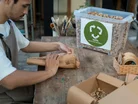
Global logistics firm DHL says that sustainable packaging will change in 2026.
The company is urging businesses to prioritise decisions around biodegradable materials and intelligent packaging solutions to attract environmentally conscious consumers who actively seek out greener brands.
This guidance follows the introduction of the Packaging and Claims Knowledge (PACK) Act by the US government, which seeks to create uniform standards for recyclable packaging claims throughout the nation.
Congressman Randy Weber, who introduced the PACK Act, says the legislation will help consumers recycle their packaging: “Americans want to do the right thing, but misleading labels make that harder.”
Biodegradable and compostable materials
DHL suggests that companies will attempt to shift away from plastic packaging in 2026, opting instead for paper-based and biodegradable options.
The company anticipates an increase in bio-based materials such as polylactic acid (PLA), a compostable plastic derived from cornstarch, alongside mushroom-based packaging cultivated from mycelium.
These materials could serve as substitutes for plastic in packaging production, offering an enhanced environmental profile as they can decompose in composting conditions within several months.
Leendert Van Delft, VP Global Sales Programmes, Marketing & Global E-Commerce at DHL, says: “Thanks to growing demand, these materials are no longer just for big-budget brands either.
“Today, SMEs can source them through specialised packaging suppliers, co-packing partners or even in ready-to-use formats designed for e-commerce.”
DHL also recommends that companies begin "lightweighting" in their packaging development, which involves using reduced material quantities whilst maintaining durability.
This can include implementing thinner cardboard, alternative folding configurations or newly engineered materials designed for strength.
These intelligent designs could reduce shipping expenses whilst decreasing emissions during the packaging production process.
Circular packaging approaches
Circularity has gained traction as packaging producers work to extend the lifespan of their products and materials.
DHL forecasts a reduction in single-use packaging, with circular packaging models building momentum.

The company suggests that by implementing circular packaging, particularly through programmes such as deposit return schemes, customers could be more inclined to make repeat purchases if there is a tangible incentive to return the packaging.
Smurfit Westrock is a leader in the sustainable packaging sector, employing a comprehensive approach to integrating circularity throughout its value chain.
The company's closed loop manufacturing model begins with utilising renewable raw materials to produce its paper-based packaging alternatives.
For instance, Smurfit Westrock has created a paper based alternative to shrink wrap for bottles, which proves robust and effective at protecting and transporting bottles.
The firm also manufactures paper based punnets for fresh produce, which are 100% recyclable, renewable and biodegradable.
Tony Smurfit, President and Group CEO of Smurfit Westrock, says: “As a company we are focused on bettering the planet, supporting our people and the communities in which we operate, while delivering impactful business.
“Smurfit Westrock aims to create the ‘go-to’ packaging partner of choice, helping our customers deliver on their sustainability goals.”
Smart packaging technology expansion
DHL predicts that 2026 will see growth in "smart packaging", which could help customers understand how to responsibly dispose of materials through QR codes and NFC tags.
One organisation demonstrating this technology is food and drink company Danone.
Danone started implementing smart packaging in 2024 on its Silk milk products.
The cartons display a QR code-enhanced How2Recycle Plus label, which was introduced by The Recycling Partnership.
The How2Recycle Plus label incorporates a Recycle Check QR code, enabling customers to access localised recycling information.
Danone reports that the smart packaging assists its consumers in participating in recycling across the US and that the company intends to incorporate the label on its other products.
Katherine Huded, Vice President of Recyclability Solutions at The Recycling Partnership, says: “With a How2Recycle label already inside nearly every home in America, the new label, featuring Recycle Check, delivers real-time information on what is accepted for recycling locally to people across the country.
“Reducing confusion on what can be recycled is essential to improving the US recycling rate.
“Real-time, location-specific education is a critical tool for recovering the 76% of what could be recycled but is instead sent to landfills or incinerators.”
Company portals

Executives

Katherine Huded
Vice President of Recyclability Solutions
Leendert van Delft
Vice President Global Sales Programs, (Digital) Marketing & Global E-commerce

Tony Smurfit
Chief Executive Officer