Foxconn to Pilot Google Intrinsic's New AI Cell for Assembly
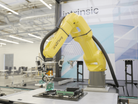
Intrinsic, Google's AI robotics company, has provided a first look at its new modular robot workcell.
The Intrinsic Intelligence Cell aims to provide a physical template to integrate AI capabilities into automation products.
Designed for complex assembly, Intrinsic says it will be piloted for electronics assembly in Foxconn production facilities later this year.
The technology is being unveiled at the Automate show in Chicago, using a FANUC robot to demonstrate electronics assembly tasks.

This collaboration follows a joint venture between the companies formed in 2025.
Announcing the partnership, Young Liu, Chairman and CEO of Foxconn, said: "In working with Intrinsic, we are able to tap their deep expertise in AI-driven robotics. This synergy complements our global manufacturing leadership, enabling us to collaboratively unlock the factory of the future."
Wendy Tan White, CEO of Intrinsic, said: “Together we’re working to bring the value of AI into the physical world."
Modular workcells
Modular workcell manufacturing is a flexible production strategy where independent, self-contained automated cells are linked together.
Each module handles a specific process, such as assembly or testing.
These can be rearranged, added to or repurposed, allowing for quick adaptation without halting the entire production line.
Individual cells can also be swapped or serviced to reduce downtime.
They are often used by companies that customise products or produce varied batches and can be used to phase-in automation, allowing for manual or semi-automated modules to be part of production and fully automated ones added later.
Many companies, including Foxconn, are investing in modular workcells, Intrinsic says.
Foxconn and Intrinsic launched a US-based joint venture in November 2025 with the aim of moving away from product-specific automation solutions and towards more general-purpose intelligent robotics.
Integrating AI in factories
In manufacturing, errors can lead to stoppages costing millions of dollars, so new technologies like AI can be a challenge to implement.
Upgrading legacy hardware and investing in systems that can handle AI can also be an enormous expense, particularly for smaller manufacturers.
Intrinsic's workcell aims to provide a headstart for integrating AI-based robotics capabilities into automation products.
It runs on IntrinsicOS, a specialised, Linux-based operating system designed to be a foundational software layer for running, managing and securing intelligent industrial robotics applications.
By taking a software-first modular approach, Intrinsic aims to make intelligent robotics accessible to manufacturers of any size.
The company says it is working with CNC system integrators, like Trinity Automation and MartinSystems, to help integrate AI skills and capabilities into next-generation products.
What is Intrinsic?
Intrinsic began as an internal moonshot project at Alphabet's X lab in 2016.
It became an independent Alphabet subsidiary in 2021 and was officially absorbed directly into Google in February 2026.
Intrinsic has grown by acquiring other robotics firms. It has acquired AI and robotics company Vicarious and several divisions of Open Robotics, the creator of the ROS open-source ecosystem.
Since becoming part of Google, the company now operates as a distinct group closely tied to Google DeepMind and Google Cloud, using Gemini AI models.
Its mission is somewhat similar to Android for smartphones. Instead of building hardware, Google is looking to create a universal AI and software platform that can run on any robot.




Executives
Wendy Tan White
CEO of Intrinsic
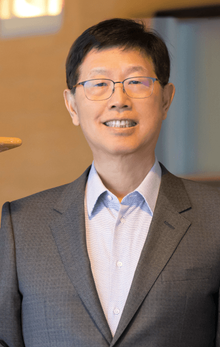
Young Liu
CEO (Chairman)