How Mondelēz Scaled Recycled Plastic for Packaging Lines
Mondelēz International's European manufacturing division has successfully integrated the company’s global target of 5% recycled content across its packaging lines.
This change, using processing recycled plastic resins, has enabled an annual reduction of around 1,000 tons of virgin plastic procurement and handling across European facilities.
The company has completed the transition of its thermoforming and tray-packing lines to accommodate rigid plastic trays containing approximately 80% recycled plastic (rPET) across several European facilities.
These operational improvements are being scaled across major European production hubs, including those in the UK, France, Spain, Germany, Austria and Switzerland, to further optimise its material supply chain.
Catherine Burgeat, Sustainability Senior Director of Europe at Mondelēz International, says: “We are proud of these milestones, as we continue accelerating our sustainable packaging journey across Europe.
“Replacing PET plastic trays with rPET is a major step towards reducing our virgin plastic usage and contributing to a more circular packaging economy.”
Advanced recycling technologies
Throughout Europe, Mondelēz is adapting its material specifications to leverage complementary recycling technologies.
Mechanical recycling provides the rPET resins used in the extrusion and thermoforming of trays for boxed chocolate brands, like Milka, Marabou, Mirabelle and Suchard, as well as biscuit lines like Milka Choco Wafer, Chips Ahoy and Oreo.
For Milka Pralines, manufacturing lines are now handling trays with ~80% rPET.
The removal of colour pigments from the polymer matrix not only improves downstream sortation but also simplifies the masterbatch requirements during extrusion.
This specification change will be scaled across other product lines to streamline procurement and meet corporate ESG targets.
To meet food-grade compliance without compromising line efficiency, Mondelēz is also securing supply chains for chemically recycled polymers.

These advanced processes break down end-of-life plastics into molecular building blocks to produce "drop-in" replacement resins.
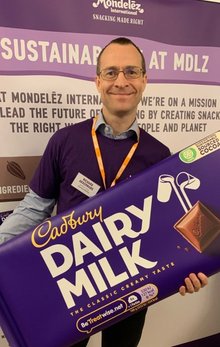
As an early adopter in Europe, the company modified its flexible film specifications for Cadbury Dairy Milk in the UK to include ~30% chemically recycled content in 2022, expanding to Nordic facilities in 2024.
By 2025, wrapping lines for Cadbury tablet packaging were upgraded to handle flexible materials containing 80% recycled plastic.
Circularity and digital sorting
Mondelēz is investing in pilot programmes in Germany, Belgium, the Nordics and the UK to close the loop on packaging waste.
In Germany, the company is adjusting the printing and moulding processes for Philadelphia tubs to integrate digital watermarks as part of the HolyGrail 2.0 initiative.
Embedding these digital watermarks directly into the packaging design requires high-resolution printing and specialised mould tooling, but it improves downstream optical sorting accuracy.
This helps to ensure a higher yield of high-quality, post-consumer resin for future manufacturing cycles.
These operational adjustments at Mondelēz contribute to Europe’s industrial shift toward circular packaging systems.
Adapting production lines to handle higher recycled content percentages ensures facilities remain compliant with tightening Extended Producer Responsibility (EPR) regulations.
Through continued capital investment in line capabilities and material innovation, the company says it aims to permanently reduce virgin plastic dependencies in its supply chain.
Richard Akkermans, Packaging Sustainability Manager Europe at Mondelēz International, says: “Innovation in both mechanical and chemical recycling technologies is essential to increasing the availability of food-contact recycled plastic.
“By working closely with suppliers and value chain partners, we are turning sustainability ambition into practical action.”
Mass balance approach
In mechanical recycling, it is relatively easy to run a physical batch of 100% recycled plastic.
Chemical recycling breaks plastic down to its molecular level to replace fossil fuels at the very start of the petrochemical supply chain.
This is then fed in alongside virgin feedstock and they mix entirely, making physical tracking impossible in most cases.
Because physical tracking cannot be done, manufacturers rely on chain-of-custody bookkeeping.
Mondelēz and Amcor use a mass balance approach certified through ISCC PLUS for chemically recycled polymers.
This means that while the company purchase enough recycled material to account for 80% of the packaging, it is mixed with virgin plastics during manufacturing.
Therefore, it cannot be guaranteed that every single wrapped contains exactly 80% recycled plastic, but the overall system allocation equals 80%.
Company portals
Executives
Catherine Burgeat
Senior Director, Sustainability Europe
Richard Akkermans
European R&D Packaging Sustainability