NVIDIA & ABB: Physical AI at Scale for Manufacturers
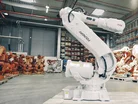
ABB Robotics has announced it will integrate NVIDIA Omniverse libraries into RobotStudio, its software programming, design and simulation suite for industrial robotics.
The partnership enables manufacturers to deploy physical AI in real-world robotics applications through accurate digital simulation and synthetic data generation.
Marc Segura, President of ABB Robotics, explains: "Using NVIDIA accelerated computing and simulation technologies, we have removed the last barriers to making industrial and physical AI a reality at a global scale by closing the sim-to-real gap."
Linking RobotStudio with Omniverse
The partnership focuses on connecting RobotStudio with the simulation power of NVIDIA Omniverse libraries, which provide a platform for physically accurate simulation.
Developers use these environments to create digital twins, allowing engineers to test processes and automation workflows in a virtual environment before deployment in real facilities.
Through RobotStudio and Omniverse, developers generate synthetic data. This refers to computer-generated datasets used to train AI models when real data is limited or difficult to capture.
The combined platform introduces RobotStudio HyperReality, which uses simulation and data feedback from real operations to refine foundation models.
Real-world operational data feeds back into the system so simulations remain accurate and continuously improve.
Deepu Talla, Vice President of Robotics and Edge AI at NVIDIA, explains: "The industrial sector needs physically-accurate simulation to bridge the gap between virtual training and the real-world deployment of AI-driven robotics at scale."

Addressing the sim-to-real challenge
The sim-to-real gap describes the difference between results achieved in simulation and performance in the real world.
In robotics development, virtual testing often fails to reflect real conditions such as lighting variation, material behaviour or environmental complexity.
ABB Robotics is addressing this challenge by integrating Omniverse libraries into RobotStudio.
According to ABB, the system delivers robotics simulation and synthetic data generation that reach up to 99% accuracy between virtual models and real-world operations.
ABB maintains an advantage through its virtual controller which runs the same firmware as the physical device.
This is combined with ABB Robotics' Absolute Accuracy, reducing positioning errors from 8 mm to 15 mm to around 0.5 mm.
Manufacturers can therefore design, test and optimise production lines virtually, reducing setup and commissioning time by up to 80% and cutting costs by up to 40%.
According to ABB Robotics' analysis, the speed at which complex products such as consumer electronics reach production lines increases by 50 per cent.
Early deployments
RobotStudio HyperReality is set to support manufacturing clients across multiple sectors.
Select customers are already testing the technology before a wider release to ABB Robotics' 60,000 RobotStudio users in the second half of 2026.
Foxconn, the world's largest electronics contract manufacturer, is piloting the first joint use case in consumer electronics assembly.
Using RobotStudio HyperReality, Foxconn trains assembly robots in a virtual environment using synthetic data before moving to real production lines with 99% accuracy.
Dr Zhe Shi, Chief Digital Officer of Foxconn, explains: "Precision is everything in consumer electronics manufacturing and, until now, this level of accuracy and fidelity just wasn't possible in simulation and digital twins."
WORKR, a California-based robotic workforce company, is extending the technology's reach to small and medium-sized businesses across the US.
At the upcoming NVIDIA GTC 2026 in San Jose, WORKR will demonstrate AI-powered robotic systems built on ABB technology.
Ken Macken, CEO and Founder of WORKR, adds: "This collaboration is about making industrial AI deployable today. Together with ABB and NVIDIA, we're proving that advanced automation can work for manufacturers of any size."
Company portals



Executives
Marc Segura
President Robotics Division