
Quality Control: The Science of Measurement in F1

Microns matter at more than 200 miles per hour. To create cars and engines worthy of the podium, everything has to be perfect. Red Bull Ford Powertrains first took to the track in Formula 1’s 2026 season, coinciding with a new set of regulations that overhauled power units and made cars more agile.
Mike Hughes, Head of QA and Manufacturing Engineering at Oracle Red Bull Racing, explains: “Fundamentally, it's an engineering challenge to extract maximum performance from a power unit constrained by the regulations: a 1.6-litre hybrid capacity, running on a specified fuel. The more power we can extract, the more competitive we are. Every fraction counts.”
Creating the car
Mike has worked with the team for two decades, and regulations are not the only things that have evolved. “What has changed is the relentless need for speed – and I don't just mean on track,” he explains. “The sooner you can finalise a component design, the sooner you can develop next season's car. The sooner you can start testing, the sooner you can optimise. And the sooner you can optimise, the sooner you can race competitively.
“If that process isn't fast enough, or if we can't be certain we've got it right, we can't win. Partners like Hexagon make the difference. After nearly 20 years of working together, we know that when we make something, measure it and take a 3D scan, the data we get back is correct.

Tiny tolerances allow the team to squeeze “every last drop of performance” from the car and ensure components fit together perfectly without pressure leaks or energy losses. For the chassis, Mike feels 3D scanning has been “transformational”, allowing everyone to be on the same page from design through manufacturing and final assembly.
“We know we're hitting those thousandths-of-a-millimetre tolerances when we need them,” Mike says. “ That means the car is built exactly as intended – we're pushing the margins of performance to the limit, within the regulations.”
A new power unit
Before the 2026 season, the team sourced its power unit externally. Around five years ago, the decision was made to start work on its own powertrain “from scratch”, explains Mark Foden, Head of Quality Control at Red Bull Ford Powertrains. “We've hired close to 1,000 people to work specifically on the power unit through Red Bull Ford Powertrains.”
Mark says: “I can't overstate the power density we're targeting in these 2026 power units. It is the absolute pinnacle of engineering and we push performance to its physical limits. So far, things are going well but that is only achievable when every component is manufactured to exact specification.
“You can design the best engine concept in the world, but if you can't manufacture it to tolerance and if it isn't reliable, you cannot win. Full stop.”
Robin Wolstenholme, Analyst and Media Relations in Hexagon’s Portable Metrology Division, says: “The Oracle Red Bull Racing mantra of ‘quality at speed’ isn’t about speeding up quality inspection – that’s the technology enabler – the lesson is about learning fast and having absolute confidence in data.
“As global carmakers face mounting pressure to halve time-to-market and increase agility at a much larger scale, the breakthroughs forged in this high-stakes environment are being translated into real-world strategies from design for inspection, to embedding pervasive digital measurements across the value chain, to model-based engineering and closed-loop quality manufacturing that reduces waste reduction and enables data-driven process optimisation.”
See this full story and more in the July 2026 edition of Manufacturing Digital.
Did you know?
Company portals



Executives

Mark Foden
Head of Quality Control
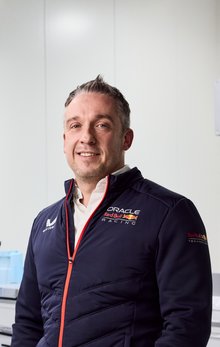
Mike Hughes
Production Enigneer