
Recycled Materials & Renewables: Manufacturing the BMW X5
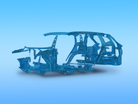
BMW Group is extending its sustainability efforts in production of the upcoming fifth generation BMW X5.
Renewable energy, process innovations and recycled materials have helped to reduce the product development process carbon dioxide equivalent emissions by 40%, it says.
The changes span the vehicle's entire lifecycle, from raw material sourcing and manufacturing through to end-of-life recycling.
BMW says it will publish a validated Product Carbon Footprint report when the model launches.

Supply chain sustainability
To achieve emissions cuts, BMW says it is focusing on renewable energy sourcing and the increased use of secondary materials across all X5 drivetrain variants.
Around 50% of the flat steel used in the BMW X5 body is electric arc furnace steel, produced using renewable energy with a high proportion of recycled content.
The company says this has been achieved through long-term collaboration with local suppliers in North America.
The battery-electric BMW iX5 60 xDrive uses sixth-generation battery cells with 28% less emissions per watt-hour than its predecessor.
These cells use a higher share of secondary materials in cobalt, lithium and nickel, and renewable energy is used in both anode and cathode material production as well as in cell manufacturing itself.
Circular materials
Secondary raw materials now feature in heavy-duty components that have not traditionally used recycled content.
Aluminium suspension parts, including wheel rims, swivel bearings, wheel supports, rear axle supports and brake callipers are manufactured using renewable energy across both electrolysis and production processes.
The aluminium used for the doors of the new X5 contains 35% recycled and closed-loop material, sourced directly from press shop offcuts at BMW's Spartanburg facility.
The headliner fabric uses yarn made entirely from 100% recycled PET as its base material.
In the battery-electric iX5 60 xDrive, secondary raw materials account for roughly one third of total vehicle weight, equivalent to around 940kg.
Plant Spartanburg
The X5 is assembled at Plant Spartanburg in South Carolina, BMW Group's largest production site.
BMW says that all external electricity used in production at the plant is from renewable sources.
Between 2006 and 2025, energy consumption per vehicle produced at Spartanburg fell by 66%. Over the same period, the volume of waste sent to landfill dropped by 88%.
A newly built high-voltage battery assembly plant in Woodruff, South Carolina, connected directly to the Spartanburg facility, also operates without fossil fuels under normal conditions. The plant produces battery systems for the electric variants of the X5 range.
Sustainability at BMW Group
BMW Group produces vehicles under the BMW, MINI and Rolls-Royce brands and is expanding its range of battery-electric and plug-in hybrid models, supported by flexible manufacturing that can build multiple powertrains on shared lines.
Its sustainability approach links reduced lifecycle emissions, supply-chain standards and circularity.
The company says it aims to achieve net zero emissions by 2050 at the latest across its entire value chain, covering the supply chain, production and the use-phase of its vehicles.
In the shorter term, it aims to save at least 60 million tonnes of carbon dioxide equivalent compared to 2019 levels.
Nicolai Martin, a Member of the Board of Management of BMW AG who oversees the Purchasing and Supplier Network, says: "Sustainability is a key element of our future-proof business model.
"The global challenges we face today are accelerating the transition to a circular economy and more sustainable, innovative technologies."
Company portals

Executives

Nicolai Martin
Board Member Responsible for Purchasing and Supplier Network