SIMOVE ANS+: How Robots can Safely Navigate Shop Floors
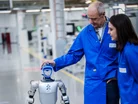
Siemens is testing its SIMOVE ANS+ navigation software on humanoid robots during live production on its Erlangen, Germany shop floor.
As factories look to automate material handling, the navigation systems guiding autonomous vehicles can provide a competitive advantage.
Siemens' SIMOVE ANS+ software is a shift away from tape-guided movement towards intelligent, adaptable navigation powered by LiDAR and simultaneous localisation and mapping (SLAM) technology.
The system serves as the eyes and brain of automated guided vehicles (AGVs) and autonomous mobile robots (AMRs), allowing for navigation using the environment rather than infrastructure changes.
“You know it's going to be an interesting day when a humanoid walks past you on the shop floor,” writes Roland Busch, CEO of Siemens, on LinkedIn.
“That software allows the robot to move autonomously through the factory, navigating alongside 30+ other autonomous mobile robots without issue.
“This is what real integration looks like: humanoid robots working in sync with existing systems and hand and hand with people to create real value.”
Replacing magnetic tape
SIMOVE ANS+ uses LiDAR-based SLAM technology to map and navigate facilities.
Rather than following magnetic tape embedded in factory floors, vehicles recognise natural features such as walls, pillars and existing infrastructure.
For environments requiring millimetre-level precision, the system supports a hybrid approach.
Artificial reflectors can be added to achieve ±10mm accuracy in dynamic production areas where natural features may shift.
The software runs on standard Siemens industrial PCs using Linux.
This architecture simplifies maintenance for facilities already operating Siemens programmable logic controllers (PLCs), reducing the need for specialised technical expertise.

Adapting to factory needs
The navigation software offers two operational modes.
Virtual Line Tracking creates strict digital paths that vehicles follow with precision.
Free Navigation enables autonomous pathfinding, allowing vehicles to calculate optimal routes around obstacles.
Dynamic obstacle avoidance continuously adjusts vehicle behaviour.
When sensors detect obstructions, the system slows, stops or reroutes vehicles automatically without human intervention.
Zone Engineering allows operations managers to digitally define movement rules:
- Speed zones regulate vehicle velocity in specific areas
- Keep-out zones protect sensitive equipment or work areas
- One-way zones manage traffic flow in congested corridors.
Map updates push to vehicles digitally, eliminating the need to physically alter floor markings when production layouts change.
This scalability can be valuable for manufacturers running multiple shifts or seasonal production variations.
Real-world performance
Tofaş, a joint venture between Koç Holding and Stellantis, deployed AGVs equipped with SIMOVE ANS+ for battery transport.
The vehicles achieved precise stopping positions at robotic assembly stations whilst navigating omnidirectionally through tight production cells.
FFT Produktions developed mobile workstations to support quality inspection processes.
Intelligent guided vehicles (iGVs) bring components directly to inspectors rather than requiring fixed inspection stations.
The system operates safely in mixed environments where humans and autonomous vehicles share floor space.
Porsche replaced rigid conveyor systems with AGV fleets at a multi-level urban production site.
The navigation software enabled the manufacturer to reclaim valuable floor space whilst maintaining the flexibility to redraw movement paths digitally as production requirements evolved.
Urban manufacturing sites cannot easily expand physical footprints, making spatial efficiency and layout flexibility critical operational advantages.
Digital infrastructure
Traditional AGV systems can require extensive physical infrastructure: magnetic strips, reflective markers or guide wires embedded throughout facilities.
SIMOVE ANS+ eliminates most of these requirements.
When production demands shift, manufacturers can reconfigure vehicle routes through software rather than scheduling downtime for floor modifications.
This capability reduces the total cost of ownership whilst increasing operational agility.
The system's integration with existing Siemens automation hardware creates a unified control architecture.
Facilities running Siemens PLCs can manage material handling vehicles through familiar interfaces, reducing training requirements and simplifying troubleshooting.
Company portals

Executives
Roland Busch
President and CEO of Siemens AG