Why Rolls-Royce Turned to Nuclear to Meet AI Energy Demands
The energy demands associated with AI pose significant challenges for sustainability in manufacturing. In particular, as industries evolve towards digitalisation, the energy required to run AI-powered operations continuously grows.
The Environmental and Energy Study Institute reports that 56% of the energy used by data centres worldwide is still supplied by fossil fuels, a figure that manufacturing leaders are keen to reduce.
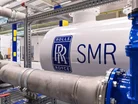
To meet these challenges, Rolls-Royce is pioneering an effort to address this challenge by powering AI operations with nuclear energy derived from Small Modular Reactors (SMRs).
This method not only promises energy efficiency but also highlights the potential of nuclear power in digital manufacturing landscapes.
The company's vision extends beyond enhancing its energy portfolio; it aims to become the UK’s leading company by value on the London Stock Exchange.
"There is no private company in the world with the nuclear capability we have," said Tufan Erginbilgic, CEO of Rolls-Royce, in an interview with BBC News.
He adds: "If we are not the market leader globally, we did something wrong."
SMRs in energy production
Rolls-Royce plans to leverage the smaller, more agile nature of SMRs compared to traditional nuclear reactors.
These reactors, capable of generating up to 300 MW of electricity, provide a scalable solution to meet both current and future manufacturing energy demands.
Rolls-Royce has committed to developing three SMRs within the UK and six additional reactors in the Czech Republic.
In its outlook, Rolls-Royce projects the need for 400 SMRs by 2050 to meet global energy demands.

The Information Technology and Innovation Foundation supports this by recognising the SMRs as future-efficient and cost-effective alternatives to existing large nuclear plants.
Examples from other industry leaders, like Google's collaboration with Kairos Power to operationalise an SMR by 2030, underline this trend.
The adaptation of nuclear technology through SMRs signifies a transformative shift in manufacturing, aligning energy efficiency with environmental conservation goals.
This technology aims to fulfil energy needs that unlock AI's full potential, revolutionising factory operations globally.
AI's role in modern manufacturing
Rolls-Royce has integrated AI into its operations since 1999, specifically to anticipate maintenance and optimise engine performance in its aircraft.
This foresight saves costs and ensures operational efficiency.
Currently, AI-driven robots conduct quality checks across manufacturing centres, further showcasing the precision and sophistication AI brings to industrial fabrication processes.
The company partners with R2 Data Labs, using data analytics to bolster its manufacturing efficacy and build a digital culture across its operations.
Technologies like mtu EnergetIQ, which evaluate energy compositions based on dynamic data inputs such as weather and electricity costs, illustrate Rolls-Royce's commitment to reducing its AI footprint.
Jan Henker, Senior Expert Automation and Controls at Rolls-Royce, says: “If you want to achieve perfect interplay in leveraging the strengths of the different technologies, not just today, but tomorrow, next week and beyond, then what you need isn't a fixed operating strategy but one that constantly recalculates itself automatically.
“That requires an over-arching, data-driven solution – in other words, the optimiser function of mtu EnergetIQ."

Future prospects with SMRs
Rolls-Royce's investment in SMRs is not solely a technological endeavour but also an economic catalyst.
Each reactor aims to deliver enough stable, emission-free energy to power one million homes for a minimum of sixty years, with a production capacity of 470 MW, comparable to 150 onshore wind turbines.
The nationwide adoption of these reactors could inject up to US$73bn into the UK economy by 2105.
Rolls-Royce plans to source 90% of its SMR components through local supply chains, ensuring high-quality production while minimising on-site disruptions.
This localised approach supports the creation of 40,000 jobs in the UK by 2050, emphasising the socio-economic benefits tied to this shift.
The forecasted development of infrastructure like SMRs opens new avenues for the industrial sector to explore clean, efficient and economically beneficial energy sources, thereby strengthening manufacturing's commitment to sustainability and innovation.