Toyota Deploys Digit: The Rise of Robots-as-a-Service
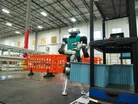
Toyota’s Woodstock factory in Canada is set to welcome a new robot team member called Digit.
After a successful pilot, Toyota Motor Manufacturing Canada has signed a Robots-as-a-Service (RaaS) agreement with Agility Robotics.
Digit will support employees with manufacturing, supply chain and logistics organisations, Agility says.
“Toyota Motor Manufacturing Canada has long been a leader in automotive manufacturing innovation,” explains Tim Hollander, President of Toyota Motor Manufacturing Canada.
“After evaluating a number of robots, we are excited to deploy Digit to improve the team member experience and further increase operational efficiency in our manufacturing facilities.”
About Digit
Digit is the world’s first commercially deployed humanoid robot.
It uses a combination of traditional controls and AI-based learning methods and can be deployed in just hours, rather than weeks or months.
Each robot contains about 5,000 parts.
Line feeding, tote loading and unloading and tote recycling are just some of the tasks it can complete.
Digit robots are manufactured in Oregon, US in Agility’s RoboFab.

At peak capacity, this facility can produce 10,000 robots each year.
What Digit will do
Toyota produces vehicles at three plants in Canada and specific components at another in British Columbia.
Woodstock West produces the RAV4 and RAV4 Hybrid and will be home to Digit.
The Canadian plants use Toyota New Global Architecture (TNGA) platforms which standardise vehicle parts and assembly processes across different models.
As part of a Can$1.1bn (US$803m) investment for the 6th-generation RAV4, the Ontario plants were reconfigured to build hybrid battery packs in-house rather than importing them from Japan.
“Toyota is one of the premier companies in the world; one with a long history of innovation and success, so it’s a privilege to join forces to integrate humanoid robotic solutions like Digit into automotive production,” says Peggy Johnson, CEO of Agility Robotics.
“I look forward to continuing our work with Toyota to identify all the ways that Digit can help the employees working at their production facilities.
“With our next generation of Digit, we will be the first company to deliver the first cooperatively safe humanoid robot to work alongside people, allowing companies like Toyota to scale their use of humanoids well beyond what is possible today.”
Robots-as-a-Service
Instead of buying the robots outright, Toyota is leasing them through Agility’s Robots-as-a-Service model.
As the robot’s hardware is improved, older models can be swapped for new ones without losing an initial investment.
Agility handles the upkeep of Digit and they are managed through Agility Arc, a cloud-based fleet management system.
This system allows plant managers to assign robots tasks through a computer, monitor the battery levels of each unit in real-time and make updates if the factory floor layout changes.
Toyota’s history with robots
While Digit is the newest robotic addition to Toyota’s team, it is certainly not the first.
The company began integrating industrial robots into its manufacturing lines in the 1970s.
Rooted in the Toyota Production System (TPS), it relied on a concept called Jidoka, meaning automation with a human touch.
Toyota used robots strictly to assist human workers and improve ergonomics, rather than attempting to automate the human craftsmen out of the factory floor entirely.
The company has been developing its own specialised industrial robots since the 1980s to optimise its vehicle production lines.
Many of the sensor and mobility control technologies it was developing for cars made sense inside robots.
Toyota co-developed Kirobo in 2013, a 34cm-tall humanoid that became the first robot to speak in space, spending 18 months orbiting Earth on the International Space Station.
In 2017, it unveiled the T-HR3, an advanced humanoid robot that mirrors the exact movements of a remote human operator.
Now with Digit, the company is relying on third-party humanoids.
Company portals


Executives
Peggy Johnson
Chief Executive Officer

Tim Hollander
President, Toyota Motor Manufacturing Canada