Water Conservation: Inside L’Oréal’s Waterloop Factories
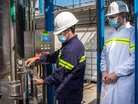
Between 2005 and 2022, L’Oréal Groupe reduced the water consumption of its plants and distribution centres by 54%.
In 2024, more than half of the water used in its industrial processes came from recycled and reused water.
L’Oréal’s Waterloop factory concept only uses mains water for human consumption and production high-quality water as a raw material.
This means that water needed for utilities, like cleaning equipment and steam production, is recycled or reused in a loop on site.
Its Burgos plant in Spain became the first Waterloop facility in 2017.
Why L’Oréal is focussed on water
From the cultivation of agricultural raw materials to manufacturing processes, the formulations of products themselves and even when consumers rinse them off, water is vital to L’Oréal’s business.

According to the WWF, 60% of global GDP is tied to water and its related ecosystems.
Manufacturing and industrial processes account for approximately 16% to 20% of global freshwater withdrawals according to the United Nations (UN).
In January 2026, a UN report declared the beginning of an era of global water bankruptcy.
“For much of the world, ‘normal’ is gone,” said Kaveh Madani, Director of the UN University Institute for Water, Environment and Health, on the report’s release.
“This is not to kill hope but to encourage action and an honest admission of failure today to protect and enable tomorrow.”
L’Oréal’s Responsible Water Use Policy
To address growing water stress across its value chain, L’Oréal created its Responsible Water Use Policy.
For manufacturing operations, the company aims to achieve water management excellence by adopting innovative technologies, maximising water recycling and reusing water for industrial processes.
L'Oréal focuses on reducing water withdrawals and adhering to strict wastewater quality standards.
The policy extends upstream, requiring strategic suppliers to manage their water impacts and undergo performance audits.
L'Oréal also evaluates the environmental footprint of its formulas, prioritising ingredient biodegradability to minimise downstream effects.
Progress is tracked against science-informed targets and overseen directly by the executive committee.
The company received an AAA rating from CDP for the 10th year running in 2025 for its work on sustainability.
“This unparalleled achievement is testament to L’Oréal’s deep-rooted commitment to fully integrate sustainability into the heart of our business strategy and across our day-to-day operations,” said Ezgi Barcenas, Chief Corporate Responsibility Officer, and Antoine Vanlaeys, Chief Operations Officer at L’Oréal Groupe.
“This recognition reflects the dedication of our teams and ecosystem.
“More than ever, we are committed to embracing innovation and collaborative partnerships for a more sustainable future.”
What makes a Waterloop factory?
To implement the Waterloop concept, L’Oréal uses a two step process.
First, industrial processes are optimised to minimise water consumption.
Then, a water recycling system is installed with pre-treatment and reprocessing technologies.
A variety of technologies can be used, including ultrafiltration, reverse osmosis and nanofiltration.
These technologies allow for the extraction of very high quality water and fully cover the water needed for utilities within the factory.
Rolling out Waterloop factories
The first of L’Oréal’s Waterloop facilities is Burgos in Spain, first set up this way in 2017.
In 2018, more facilities were added in Italy, Russia and Belgium.
Libramont in Belgium recycles about 60 million litres of water every year.
Yichang in China followed in 2021 as the first Waterloop factory in North Asia, saving more than 15,000 tonnes of water per year.
L’Oréal’s first Waterloop in the Americas is in Mexico City, Mexico which is an area with high water stress.
The company’s environmental reports say that its ambition is to roll out this concept to all 39 of its factories by 2030, prioritising those in high water stress areas like Egypt, India and South Africa.
L’Oréal’s Burgos factory in Spain
L'Oréal's International Hair Care Products Factory in Burgos was established in 1971.
It was one of the company’s first to reach carbon neutrality in 2015 through the introduction of a biomass trigeneration plant.
This enables it to use 100% renewable energy.
In addition to becoming the first Waterloop factory, the Burgos Green Lines project created a sustainable corridor of trains and ships to reduce Scope 3 emissions.
L'Oréal says this helped to achieve a 20% decrease in carbon emissions associated with transportation.
In 2016 it was certified as a zero waste to landfill facility.
A greenhouse at the factory is used to dry sludge, the primary waste generated by the plant, which uses solar energy to reduce its volume by 50%.
This waste then requires less transportation and further reduces emissions.
The Yichang Waterloop plant
In China, L'Oréal's Yichang factory makes makeup products for the L'Oréal Paris, Maybelline and Yue-Sai brands with 400 staff.
It adopted the Waterloop system in 2021 after trialling the closed loop and water recovery and treatment system in 2020.
A detailed water consumption study was also carried out to find potential sources of water savings.
It found that the cooling tower consumed more than 20% of water used by the facility, so this was replaced by an air cooler in 2021.
Yichang Plant Director Emy Lu explains: “The plant has always strictly implemented the Group’s resources and energy efficiency targets by implementing multiple initiatives, including enhancing awareness of water-saving among employees, improving cleaning efficiency and reusing water for gardening for instance.
“In 2020, the plant’s water consumption was reduced by 85% compared with 2005.”
Company portals

Executives
Antoine Vanlaeys
Chief Operations Officer I Member of the Executive Committee

Emy Lu
Plant General Manager
Ezgi Barcenas
Chief Corporate Responsibility Officer
Kaveh Madani
Director