What’s Inside the World’s Smartest Factories?
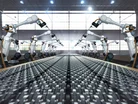
AI has generated more cost savings in manufacturing than in any other industry, according to McKinsey. Working in tandem with advanced technologies, including robotics and IoT, many processes in smart factories can now run themselves with minimal human intervention.
Facilities are building on smart factory foundations to become cognitive networks, integrating hybrid human-AI workforces and ecosystems of intelligent agents.
Smart factories have four core ingredients:
- industrial IoT (IIoT)
- big data and analytics
- digital twins
- robotics.
When these come together, maintenance becomes predictive, agility increases and efficiency can soar. Once AI is added to the equation, productivity can skyrocket.
The smartest factories
The World Economic Forum’s (WEF) Global Lighthouse Network recognises manufacturing sites and value chains leading in Fourth Industrial Revolution (4IR) technologies. It was launched in 2018 and has grown to cover more than 220 sites demonstrating exceptional performance across 35 countries.
Analytical and generative AI is being embedded into core operations across Lighthouse factories to allow agile, autonomous decision-making. Where some organisations are trying to figure out generic horizontal AI tools, the WEF says lighthouses are focussed on vertical applications. Analytical AI and machine learning cover the majority of use cases and generative AI has grown to cover 23%.

Adoption of these technologies does not, however, guarantee impact. Well-defined transformation roadmaps, agile teams and global ecosystem partnerships are some of the factors the WEF says help to scale AI and technologies beyond a single factory to reach the advantages of scale.
Manufacturing leaders’ plans
Deloitte’s 2026 Manufacturing Industry Outlook says that the industry as a whole is moving from experimental AI pilots to at-scale implementation. Success, it says, depends on balancing aggressive technology investment with highly adaptive workforce strategy.
The top concern for more than a third of manufacturing executives in a 2025 Deloitte survey was “equipping workers with the skills and knowledge they need to maximise the potential of smart manufacturing and operations”. If the trend toward reshoring accelerates, Deloitte says that the supply of skilled workers could become more strained.
A survey of 600 manufacturing executives found that 80% plan to invest 20% or more of their improvement budgets in smart manufacturing initiatives. These investments will focus on foundational tools and technologies including automation hardware, data analytics, sensors and cloud computing.
The report highlights agentic AI as “poised to elevate smart manufacturing and operations” and expects industry adoption of agentic AI to grow considerably in the next few years. Deloitte says that agentic AI “lays the foundation for physical AI”, which nearly a quarter of manufacturers plan to use in the next two years according to a survey conducted by the Manufacturing Leadership Council.
Trade uncertainty remains the top concern for 78% of manufacturers according to the National Association of Manufacturers’ 2025 Q3 manufacturers’ outlook survey. Agentic AI could provide enhanced visibility and agility by autonomously detecting and mitigating supply chain risk. The report says that targeted investments in digital tools, including agentic AI, “could be essential for manufacturers to maintain a competitive edge in 2026 and beyond”.
The smart factory power list
1. Siemens - From hardware to software and AI, Siemens’ solutions like TIA Portal and Xcelerator are used in factories around the world.
2. ABB - ABB’s tools like RobotStudio Suite help manufacturers to visualise ideas and reduce commissioning time.
3. Schneider Electric - Schneider’s EcoStruxure platform and AVEVA Insight software give managers a single dashboard to track power waste and carbon emissions.
4. Rockwell Automation - Rockwell’s PavilionX and ResilientEdge software run Predictive Control models that can automatically adjust machine settings.
5. Honeywell - Data from Honeywell’s Forge platform helps factory managers reduce energy waste and predict when a machine might fail.
6. Microsoft - Microsoft Azure IoT acts as the data backbone for smart factories, storing and analysing information from thousands of sensors at once.
7. Fanuc - Fanuc’s CRX cobots and Zero Down Time (ZDT) software are built for factories that need high-speed production.
8. Dassault Systèmes - Dassault Systèmes provides the high-end simulation tools needed to plan, test and optimise a factory’s performance before it even opens.
9. PTC - PTC’s ThingWorx and Vuforia bridge the gap between physical machines and digital data using IoT and Augmented Reality.
10. Tulip - Tulip’s no-code Frontline Operations Platform lets shop floor workers build their own custom apps for tracking quality and following instructions.
Siemens’ Nanjing Global Lighthouse
Siemens' AI powered facility in Nanjing, China was named a WEF Global Lighthouse Factory in January 2026. This plant is Siemens’ fifth to be named a Lighthouse Factory following three in Germany and a fourth in Chengdu, China.
The Nanjing facility is the company’s largest research and production centre for CNC systems, drives and electric motors outside Germany. The WEF’s award highlights improvements in asset utilisation, worker enablement and resource management.
Cedrik Neike, Member of the Managing Board of Siemens and CEO Digital Industries, says: "We call our Nanjing facility a 'digital-native factory'. It was designed, tested and optimised entirely in the virtual world before a single brick was laid.
“By combining our global manufacturing expertise with local insight and a digital-first mindset, we continuously optimise every part of the operation, making it one of the most efficient and flexible factories in the world.”
Alongside its Global Lighthouse Factories, Siemens creates its own technologies that support factories around the world, including Digital Twin Composer used by PepsiCo, nine specialised AI copilots and programmes like Building X and Power Intelligence.
ABB’s smart factory solutions
Energy management and machine automation make ABB a big part of smart factories around the world.
While AI and high-compute machines make factories more productive, they can also consume a lot of power. ABB provides energy intelligence, such as digital switchgear and microgrids, that can make facilities more efficient.
B&R Industrial Automation is part of its Process Automation division, specialised in track systems and planar motors. The company also provides PCs and PLCs that can act as the brain of an entire production line, orchestrating machines from multiple different vendors.
ABB Ability is the company’s industrial AI and data platform that pulls information from every smart device in a factory into one dashboard. Before a manufacturer changes their assembly flow, simulations can be run in its digital twin environment.
As factories become more connected to the cloud, they also become bigger targets for cyber attacks. ABB provides industrial-grade firewalls and secure edge gateways that keep the factory floor safe.
Schneider Electric’s sustainable smart tech
Schneider’s Electricity 4.0 framework has positioned the firm as an architect of the sustainable, digital factory. By bringing together power management with industrial automation, the company aims to eliminate energy waste in high-compute manufacturing environments.
The EcoStruxure platform acts as the company’s digital backbone, using IoT and edge computing to connect the shop floor directly to the cloud. Following the full integration of AVEVA, Schneider also offers End-to-End Digital Twins that allow manufacturers to simulate entire production lifecycles, reducing commissioning times by up to 30%.
In late 2025, Schneider’s Kentucky, US Advanced Lighthouse Factory successfully piloted Universal Automation. This IEC 61499-based technology decouples automation software from the underlying hardware, allowing factories to run logic across different vendors' machines without re-coding.
To address the surge in industrial energy demand, Schneider’s ProClima and Microgrid Advisor use predictive AI to balance power loads in real-time. These systems ensure that as factories scale up their AI processing power, they remain carbon-neutral by automatically shifting to onsite renewable sources during peak demand.