
Top 10: Additive Manufacturing Companies
Since the invention of stereolithography (SLA) in the 80s, 3D printing has gone through a lot of changes.
Initially used for rapid prototyping, today this technology is used for medical and aerospace-grade parts in mass production.
The global additive manufacturing industry is valued at US$24.2bn according to the Wohlers Report 2026, and printing parts for end-use and production has grown by 15.5%.
Every part produced by a machine can be unique, and many are lighter than their predecessors without compromising performance or durability.
Manufacturing Digital has ranked 10 of the top additive manufacturing companies.
10. Xometry
Incoming CEO: Sanjeev Singh Sahni
Headquarters: Maryland, US
Founded: 2013
Xometry offers an AI-native marketplace that connects enterprise buyers with a global network of suppliers.
Its Instant Quoting Engine generates a binding price and lead time, using AI to analyse the geometry of a CAD file, calculate material costs and assess supplier capacity.
To grow in the aerospace, defence and medical markets, Xometry has added eight new high-performance materials to its fused deposition modelling (FDM) and SLA lines.
This includes advanced composites like Nylon 6 CF, ULTEM 1010, PAEK VICTREX AM 200 and high-temperature resins like Accura SL 5530.
9. Formlabs
CEO: Maxim Lobovsky
Headquarters: Massachusetts, US
Founded: 2011
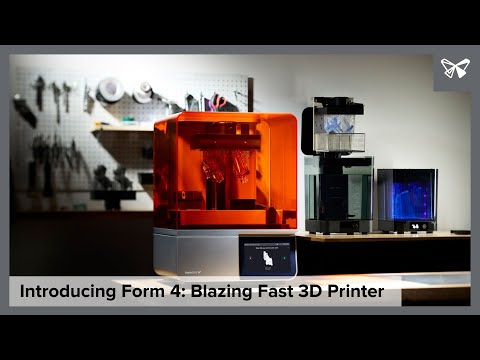
Founded by MIT grads, Formlabs disrupted the 3D printing market by taking SLA out of the hands of massive service bureaus and putting it on the engineer’s bench.
The company is targeting the pain points of traditional injection molding like cost and lead times.
Its Form 4 Ecosystem uses proprietary low force display (LFD) print engine, which is a masked stereolithography (mSLA) approach.
Instead of a laser tracing every layer, an LCD screen cures the entire layer simultaneously with a high-power power backlight.
8. Nikon SLM Solutions
CEO: Sam O'Leary
Headquarters: Lübeck, Germany
Founded: 2006
Before its acquisition by Nikon in 2023, SLM Solutions was a pioneer in selective laser melting (SLM).
Its NXG XII 600 has 12 thousand-watt lasers operating simultaneously, making it up to 20 times faster than a single-laser system.
Nikon SLM integrates systems like Additive Assurance that uses near-infrared optical tomography to monitor all lasers in real-time, keeping track of quality throughout the process.
The system operates on an open material architecture, allowing operators to fully customise process parameters.
7. Bright Laser Technologies
CEO: Xue Lei
Headquarters: Xi'an, China
Founded: 2011

Around a quarter of staff at Bright Laser Tech (BLT) are R&D personnel and significant amounts of its revenue go into new research.
Its machines like the BLT-S1500 and BLT-S1300 use 26-laser arrays, allowing for large single components or hundreds of smaller parts to be printed at once.
The BLT-XH500 integrated powder circulation system automates the recycling, sieving and supply of metal powder in a closed loop.
This reduces human intervention, safety risks and machine downtime.
6. Materialise
CEO: Brigitte de Vet-Veithen
Headquarters: Leuven, Belgium
Founded: 1990
Materalise has more than 35 years of experience and operates one of the world’s largest 3D printing facilities.
Its data and build-preparation software Magics has thousands of active users and its CO-AM platform is designed to manage the entire additive manufacturing workflow.
HP’s new MJF 1200 3D printers now come bundled with Magics Print for HP as part of the CO-AM ecosystem, aiming to simplify the path from design to printed part.
Materialise is also a founding member of the Leading Minds Consortium that works to eliminate silos and fragmentation in AM.
5. Colibrium Additive
CEO: Alexander Schmitz
Headquarters: Ohio, US
Founded: 2016
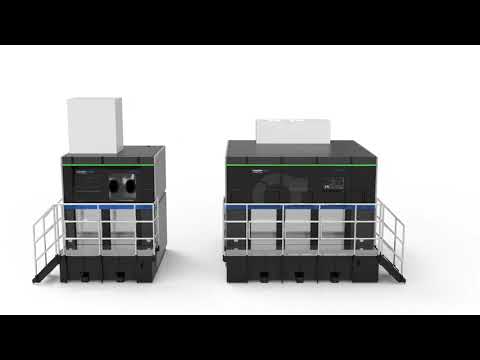
Part of GE Aerospace, Colibrium holds strong IP in direct metal laser melting (DMLM), electron beam melting (EBM) and metal binder jet.
The company was born out of GE’s need to manufacture the LEAP engine fuel nozzle, a part that consolidated 20 components into one.
Its AddWorks team of embedded engineers helps clients to bridge the gap between printing a prototype and certifying the part for regulated, scaled production.
The company also owns AP&C and produces in-house metal powders.
4. EOS
CEO: Marie Langer
Headquarters: Krailling, Germany
Founded: 1989
Unlike companies that started in desktop prototyping, EOS has almost exclusively focused on industrial-grade, manufacturing-ready systems.
It specialises in powder bed fusion (PBF) and is the pioneer of direct metal laser solidification (DMLS) and selective laser sintering (SLS), with more than 4,000 systems installed worldwide.
EOS develops the entire technology stack from metal and polymer powders to its own data preparation software EOSPRINT.
This vertical integration allows it to offer validated parameters.
3. HP
CEO: Bruce Broussard
Headquarters: California, US
Founded: 1939

HP has adapted its 2D inkjet heritage for the 3D space, providing multi jet fusion (MJF) solutions for polymers and metal jet solutions for metals.
The company has introduced the HP Multi Jet Fusion 1200 solution, a more compact and accessible system that brings industrial-grade MJF capabilities to a wider range of teams and applications.
“As we mark a decade of innovation in additive manufacturing, these latest advancements across our portfolio reflect HP’s focus on bringing industrial-grade capabilities closer to where ideas take place,” says Alex Moñino, SVP and GM at HP Additive Manufacturing Solutions.
“By lowering cost per part and simplifying workflows, we are making it easier for customers to adopt additive manufacturing and scale it across new applications.”
2. Stratasys
CEO: Yoav Zeif
Headquarters: Minnesota, US
Founded: 1989
Stratasys is the company that invented fused deposition modelling (FDM).
It has grown into a polymer powerhouse now running five distinct technology stacks under one roof.
Stratasys’s PolyJet J850 Core is built specifically for engineering teams to do functional prototyping quickly, stripping out full-colour features to lower the cost of entry.
For high-throughput mass production, it uses its selective absorption fusion (SAF) systems which rival powder-bed systems.
It has acquired Covestro’s additive manufacturing materials business, absorbing around 60 specialised materials and hundreds of patents to vertically integrate into its polymer ecosystem.
Stratasys has also partnered with Shin-Etsu to introduce P3 MED Silicone 25A, the first fully certified biocompatible true silicone for 3D printing.
1. 3D Systems
CEO: Jeffrey A. Graves
Headquarters: South Carolina, US
Founded: 1986

3D Systems was Co-Founded by Chuck Hull, an inventor and patent-holder of SLA and the STL file format.
The company now describes itself as a “full-service solutions partner” for 3D printing, delivering technologies, material and software to a variety of industries.
“Over the past several years, we’ve made disciplined investments to refresh our portfolio and focus on manufacturing applications where additive delivers the greatest value,” says Dr. Jeff Graves, President and CEO of 3D Systems.
Patrick Dunne, SVP and Technical Fellow at 3D Systems, says: “The industrialisation of additive manufacturing continues to accelerate as more companies realise its ability to deliver both performance gains through design innovation and operational flexibility through digital production.”