Top 10: Industrial IoT Platforms
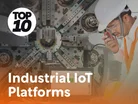
Industrial IoT (IIoT) supports modern AI solutions, connecting OT with IT and can even help to reduce environmental impact.
According to McKinsey, less than 30% of IIoT pilots ever reach enterprise scale and 84% of companies are stuck running pilots for more than a year.
Factories that successfully scale their digital transformations achieve an ROI of two to three times within three years and four to five times within five years, according to the World Economic Forum's Global Lighthouse Network.
Manufacturing Digital has ranked 10 of the top IIoT platforms.
10. Litmus Edge
CEO: Vatsal Shah
Headquarters: California, US
Launched: 2015
Litmus Edge is designed to send ready-to-use data into cloud platforms like Microsoft Azure or Databricks.
It has native support for more than 250 industrial protocols and processes data locally.
For enterprises with hundreds of factories, the Litmus Edge Manager acts as a centralised control plane that can deploy new AI models and monitor edge gateways from a single dashboard.
9. Hitachi Lumada
CEO: Akinobu Shimada
Headquarters: Tokyo, Japan
Launched: 2016

Hitachi Lumada focuses on DataOps, aiming to unify IT and OT with business data to support intelligent automation.
Pentaho is the company’s enterprise-grade data integration and analytics engine that ingests, cleanses and blends legacy OT data with cloud IT data without requiring large amounts of custom engineering.
Lumada’s digital twins correlate machine telemetry with worker records, material batches and production methods to give a holistic view of the factory floor.
8. Univers EnOS
Global Executive Director: Michael Ding
Headquarters: Singapore
Launched: 2017
EnOS is an operating system designed for energy management and industrial decarbonisation.
It currently connects more than 365 million smart devices globally and manages roughly 845 GW of renewable energy assets.
EnOS Edge and EnOS AI Box, powered by AMD, allow for real-time, low-latency decisions for tasks like balancing local microgrids.
It uses more than 360 pre-built AI models to continuously optimise the balance between a factory's power consumption, on-site power generation and battery storage.
7. CONNECT
CEO: Caspar Herzberg
Headquarters: Cambridge, UK
Launched: 2024

Now part of Schneider Electric, AVEVA’s CONNECT aims to be the foundational digital twin platform.
Built heavily on Microsoft Azure, CONNECT is a neutral digital backbone. It bridges the gap between on-premises legacy systems and advanced cloud AI.
Integration of the OSIsoft PI System allows it to handle high-speed, high-volume data.
CONNECT integrates 3D CAD models, P&ID and 3D laser scans to allow operators to visually walk through a facility’s digital twin.
6. ABB Ability Genix
CEO: Morten Wierod
Headquarters: Zürich, Switzerland
Launched: 2020
ABB’s Genix Industrial Analytics and AI Suite is its flagship industrial platform and aims to integrate OT, IT and engineering technology.
The company has formed a strategic partnership with Microsoft, using its Azure cloud backbone and OpenAI services alongside its own industrial domain expertise.
Genix can accurately predict how an asset should be performing versus how it is actually performing, allowing for highly accurate anomaly detection.
5. Cumulocity IoT
CEO: Bernd Gross
Headquarters: Düsseldorf, Germany
Launched: 2012

Cumulocity leaves space for manufacturers to customise without requiring new infrastructure to be built from scratch or being a closed-box application.
It is hardware and cloud-agnostic, able to run on AWS, Azure, Google Cloud or directly at the edge.
It uses an open-source edge framework and offers hundreds of ready-to-use protocol adapters.
Cumulocity says that industrial devices can be registered in under five minutes and managed through the entire lifecycle.
4. AWS IoT
CEO: Matt Garman
Headquarters: Washington, US
Launched: 2015
Over the last decade, AWS has evolved its IoT offering from a simple, secure message broker into a highly specialised industrial portfolio.
It focuses on edge computing and digital twins to optimise production, perform predictive maintenance and monitor asset health at a global scale.
Industrial data pipelines feed seamlessly into Amazon S3, Amazon SageMaker and Amazon Bedrock.
Through AWS IoT Greengrass, manufacturers can run cloud-native services and serverless functions locally on edge servers.
3. Microsoft Azure IoT
CEO: Satya Nadella
Headquarters: Washington, US
Launched: 2016

Azure IoT is a highly scalable, edge-to-cloud data foundation built entirely on Kubernetes, open standards and AI readiness.
It relies heavily on Azure Arc to manage edge servers on the factory floor, just like cloud resources, feeding normalised OT data directly into the Azure cloud for real-time analytics and Copilot-driven AI.
The platform uses an enterprise-grade MQTT broker for messaging and native OPC UA connectors to talk to industrial assets.
2. Siemens Insights Hub
CEO: Roland Busch
Headquarters: Munich, Germany
Launched: 2016
Insights Hub is a cloud-based IIoT-as-a-service solution that collects and visualises real-time data and analytic results in one centralised location, built for enterprise-scale manufacturing programmes.
It is a core component of Siemens’ Industrial Operations X portfolio, part of Xcelerator.
The platform is deeply integrated with Mendix, a low-code platform that allows teams to build custom applications and operational dashboards quickly.
Insights Hub uses predictive machine learning to forecast machine failures before they happen and applies AI to detect production anomalies.
It offers enterprise-grade security, data encryption and compliance with global manufacturing standards.
1. ThingWorx
Velotic CEO: Brian Shepherd
Headquarters: Massachusetts, US
Launched: 2011

ThingWorx has almost unmatched versatility, natively integrating Kepware and Vuforia to bridge the gap between machines and the people operating them.
ThingWorx’s Kepware integration allows the platform to talk to more than 150 different proprietary machine protocols.
Rather than a pre-built dashboard, it provides the building blocks to create custom ones. Its Mashup Builder is a drag and drop interface that creates custom control panels, data visualisations and mobile apps without writing code from scratch.
By monitoring vibration and temperature, the platform can predict when a motor will fail before it breaks, reducing unplanned downtime.
Its connected work cells provide frontline workers with interactive, digital work instructions that change in real-time.
ThingWorx is not an instant solution, requiring dedicated IT resources and network architecture, but its IIoT solutions are comprehensive and flexible.
It is also the underlying engine for Rockwell’s FactoryTalk InnovationSuite.
Created by PTC, TPG has announced it will acquire ThingWorx and Kepware in 2026 under Velotic.
Company portals











Executives

Akira Shimada
President and CEO
Caspar Herzberg
Chief Executive Officer
Matt Garman
Chief Executive Officer
Morten Wierod
CEO
Roland Busch
President and CEO of Siemens AG
Roland Busch
President and CEO of Siemens AG
Satya Nadella
Chairman and CEO