
How is Automation Used in Manufacturing?
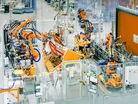
Automation is more than just robotic arms doing repetitive tasks.
Industry 4.0 is where machinery meets data, and this combination allows for more than just physical tasks to be automated.
Modern automation is a blend of hardware, like robots and conveyors, with software, like AI and ERP systems.
Claire Fallon, CEO of the International Society of Automation, says: "The world relies significantly on automation technologies and skilled automation professionals — and that reliance will only deepen in the years to come as industries and economies evolve.
"Global economic growth is tied closely to the successful implementation of automation and the skilled workforce to put these technologies in place."
Overall equipment effectiveness
Overall equipment effectiveness (OEE) takes the theoretical maximum capacity of a factory floor and compares it to what is actually being produced.
A score of 100% OEE means you are manufacturing only good parts as fast as possible with no stop time.

In reality, a world-class OEE score for discrete manufacturing is widely considered to be around 85%.
This is calculated based on availability, performance and quality and automation is a driving force behind maximising all three.
Predictive maintenance can predict failures before they happen, using IoT sensors to monitor machine health.
Automated systems can swap tooling, adjust rail widths or change programming for a new product batch in seconds or minutes, where manual changeover may take hours.
Robots and automated systems do not get tired or distracted, operating at a constant cycle time 24/7.
Automated Guided Vehicles (AGVs) or autonomous mobile robots (AMRs) ensure that raw materials are delivered to the machine the exact second they are needed, eliminating idle time caused by operators waiting for parts.
Automated machinery performs tasks with microscopic precision every single time.
A CNC machine or a robotic welder will execute a task identically on the 10,000th unit as it did on the first, reducing scrap caused by human error.
Without data visibility, OEE was calculated using stopwatches and clipboards, meaning data was always reactive and often inaccurate.
Workplace safety and ergonomics
Automation can drastically reduce musculoskeletal disorders (MSDs) caused by repetitive strain and heavy lifting.
Robots can handle tasks involving extreme heat, toxic chemicals and heavy payloads instead of putting humans at risk.
Where humans are needed, some manufacturers have integrated exoskeletons on assembly lines to reduce the strain on a worker's shoulders, back and knees during repetitive overhead tasks or deep bending.
In partnership with Ekso Bionics, Ford rolled out upper body exoskeletal technology in 2019.
The EksoVest can help to reduce injury risk when carrying out repetitive overhead tasks and provides lift assistance of up to 15 pounds per arm and supports a worker’s body during tasks like reaching up to screw in bolts.
The vest was piloted at Fords’ Michigan Assembly Plant before expanding to 15 plants in seven countries around the world.
Cobots are equipped with force-limiting sensors that allow humans and machines to work together safely.
AMRs navigate using LiDAR and advanced sensors. Unlike a human driving a forklift with blind spots, an AMR has a 360-degree view.
Automation also extends to how workers are trained to handle dangerous situations.
Companies are using virtual reality (VR) linked to digital twins, where new employees can practice operating machinery, clearing jams or responding to shutdowns in a safe digital environment.
Sustainability and energy efficiency
Automation can also help manufacturers to reach their environmental, social and governance (ESG) goals.
Automated building management and machine controls can optimise energy use, for instance by powering down idle machinery.
IoT sensors can read the ambient temperature and heat output of running machines, automatically adjusting HVAC systems to reduce wasted electricity.
Precision automation also helps to reduce material waste and scrap rates.
Automated sorting systems using machine vision can separate offcuts and waste materials on the line.
In water-heavy or chemical-heavy manufacturing, automated closed-loop fluid systems monitor pH levels and contamination.
Instead of constantly flushing and replacing millions of gallons of water, systems can automatically filter and recycle it indefinitely.
Modern SCADA and ERP systems automatically track energy consumption, material usage and emissions down to the individual machine level to support ESG reporting.
AI in factories
The World Economic Forum’s (WEF) Global Lighthouse Network recognises manufacturing sites and value chains leading in Fourth Industrial Revolution (4IR) technologies.
Analytical and generative AI is being embedded into core operations across Lighthouse factories to allow agile, autonomous decision-making.
Where some organisations are trying to figure out generic horizontal AI tools, the WEF says lighthouses are focussed on vertical applications.
Adoption of these technologies does not, however, guarantee impact.
Well-defined transformation roadmaps, agile teams and global ecosystem partnerships are some of the factors the WEF says help to scale AI and technologies beyond a single factory to reach the advantages of scale.
Company portals






Executives

Claire Fallon
CEO/Executive Director