Accenture & General Robotics: Robots & AI for 'Any Task'
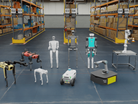
Professional services giant Accenture has invested in General Robotics, an AI research and deployment company, to advance autonomous operations with physical AI.
Both companies use the NVIDIA Omniverse in operations for physical AI deployment.
General Robotics says it offers general-purpose robotic intelligence which allows organisations to rapidly deploy and continuously adapt robots of “any form, with any AI, for any task”.
This comes at a time when many companies are scaling physical AI operations in manufacturing, including the deployment of humanoid robots.

Why Accenture is investing in General Robotics
Accenture and General Robotics say the partnership will help manufacturers, logistics companies and clients in other asset-intensive industries advance autonomous operations with physical AI. The terms of the investment were not disclosed.
Prasad Satyavolu, Global Lead for Manufacturing and Operations at Accenture, says: “Physical AI-powered robotics address issues our clients are facing, such as workforce constraints, challenged factory and warehouse productivity and continuously rising capital and operational costs.”
Accenture has expertise in physical AI and manufacturing, logistics and other asset-intensive industries including utilities, energy and aerospace. The firm, which is headquartered in Ireland, employs roughly 786,000 people.
Accenture uses NVIDIA Omniverse libraries, the Mega NVIDIA Omniverse Blueprint and the NVIDIA Metropolis platform for the deployment of visual AI agents as part of its Physical AI Orchestrator solution for software-defined factories and warehouses.
Prasad continues: “Often, piloting robotic systems takes too long, is expensive and often not scalable and repeatable across a network of facilities.
“Our partnership with General Robotics will focus on delivering an enterprise-grade robotics intelligence and orchestration layer that will assist companies in deploying robotic systems safely, efficiently, faster and at scale.
"It will help our clients create a much-needed hybrid agentic, physical and human workforce that supports the competitive future of plant and warehousing locations.”
General Robotics technology
General Robotics’s unified intelligence platform General Robot Intelligence Development platform (GRID) is designed to connect robots across robotics original equipment manufacturers.
The company says GRID is composed of foundation models, large language models and is designed for prototyping intelligent and safe robotic capabilities.
The platform focuses on modular, reusable AI skills, cloud-based orchestration, simulation training, sovereignty over data and intellectual property.
NVIDIA Isaac Sim, an open reference framework for robot simulation built on NVIDIA Omniverse libraries, is integrated into General Robotics’s GRID platform.
Ashish Kapoor, CEO and Co-Founder of General Robotics, says: “While robotics hardware and AI models advance at a rapid pace, real-world impact is constrained by the lack of a unified intelligence infrastructure.
“We’re providing the intelligence grid that connects robots, agents and AI models through a single platform designed to speed deployment and adapt as AI advances and robotic tasks become more sophisticated.
"Partnering with Accenture will allow us to support companies in applying these capabilities at scale and in a way that supports their business priorities.”
Physical AI in manufacturing
Physical AI is essential to scaled robot deployment as it enables simulations of factories and warehouses that adhere to real-world conditions.
Accenture says that its simulations will let companies find more effective configurations for their robot fleets before deploying them at the actual sites.
According to a whitepaper from the World Economic Forum, AI can solve some of the most persistent problems in manufacturing and tap into new opportunities that allow companies to increase their operational performance, drive the sustainability agenda and empower the workforce.
McKinsey argued in April 2026 that robotics is ready to cross the gap from simulation to reality.
Company portals



Executives

Ashish Kapoor
CEO and Co‑founder
Prasad Satyavolu
Lead- Industry X; Americas