NVIDIA, Siemens & Schneider: AI on the Factory Floor
Manufacturing is moving into a new phase of artificial intelligence deployment. What began as theoretical discussion has shifted to measurable outcomes on production floors across Europe.
Hannover Messe 2026 opened with more than 3,000 exhibitors demonstrating how robotics and automation deliver competitive advantages.
The event in Germany brings together technology firms addressing industrial challenges through physical AI, generative systems and agentic software.
Physical AI in production environments
Siemens is using the event to show how autonomous systems perform tasks beyond advisory functions. The company has set up a flexible shoe production line where AI takes direct action rather than offering recommendations.
The demonstration centres on work between Siemens, NVIDIA and robotics company Humanoid.
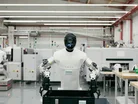
The HMND 01 wheeled Alpha humanoid robot operates at the Siemens electronics factory in Erlangen, Germany, performing autonomous logistics functions. The robot navigates factory environments whilst adapting to changing production requirements in real time.
Deepu Talla, Vice President of Robotics and Edge AI at NVIDIA, says: "Factories of the future demand robots that can perceive, reason and adapt autonomously alongside human workers, tackling the labour shortages and operational complexity that traditional automation struggled to handle.
"With Siemens providing the industrial integration backbone and Humanoid deploying NVIDIA's full physical AI stack – from simulation-first training to real-time edge inference, this deployment paves the way for humanoid robots meeting real production targets on a live factory floor."
According to NVIDIA, the system achieves 60 tote moves per hour whilst picking and placing containers for operators. This performance level matches human workers in similar roles, demonstrating that physical AI has reached practical viability for materials handling applications.
The robot integrates with existing machinery through the Siemens Xcelerator portfolio. This creates what Siemens describes as a simulation-first environment for rapid scaling and real-time edge inference. The approach allows manufacturers to test robot behaviour in virtual environments before deploying physical systems.

Agentic software
Schneider Electric is demonstrating agentic software in partnership with Microsoft. The companies claim the technology cuts engineering time by up to 50%.
The Schneider Industrial Copilot runs on Microsoft Azure AI. Early adopter h2e POWER, an Indian green hydrogen supplier, has reported outcomes from deployment.
According to h2e POWER, the system delivered:
- 6,000 hours of stable autonomous operation
- 10% reduction in the levellised cost of hydrogen
- €500,000 (US$588,000) in estimated savings.
Siddharth Mayur, Founder of h2e POWER, says: "With Schneider Electric's open, software‑defined automation and Microsoft's AI capabilities powered by Azure, our systems are becoming smarter, more responsive, safer and dramatically more scalable.
"This open architecture also means we can redeploy intelligence across our entire installed base across multiple locations, without the lock‑in that has constrained industrial innovation for decades."

Deployment barriers
Schneider Electric has formed partnerships with Dell Technologies and AWS to address infrastructure requirements. Many manufacturers face challenges not with AI itself but with the systems needed to run it. The computational demands of AI workloads require significant upgrades to existing factory IT infrastructure.
Schneider and Dell are showing what they call a future-ready foundation covering the AI deployment lifecycle. The framework includes OT groundwork through ProLeiT, digital twin design via AVEVA and NVIDIA Omniverse, and modular infrastructure using Dell solutions for scaling.
Schneider is also demonstrating how its EcoStruxure Automation Expert operates on AWS. The system uses Amazon EC2 for virtualised control and AWS IoT Greengrass at the edge.
Data sovereignty
The boundary between information technology and operational technology continues to shift. Efficiency and data control remain central concerns for industrial companies.
"Robust IT infrastructures are now the foundation of global competitiveness. We help industrial companies securely integrate cloud, AI and IT services into their processes to dramatically increase efficiency whilst keeping control over their own data," says Bernd Wagner, CSO of Schwarz Digits, the IT division of Schwarz Group.
The demonstrations at Hannover Messe 2026 suggest pilot programmes are ending and factories are moving from testing AI to integrating it into operations.
Company portals








Executives
Bernd (Bernie) Wagner
CSO Schwarz Digits
Deepu Talla
Vice President and General Manager - Robotics & Edge AI
Siddharth Mayur
Founder, Executive Director