
What is Siemens’ Modular Robot for Food Manufacturers?
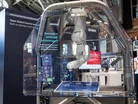
Siemens has unveiled a new open robotics platform for food manufacturers.
The company has worked alongside Wymbs Engineering and HMK Automation & Drives to create a modular solution able to tackle variable materials using AI.
The technology aims to help food manufacturers with depositing, filling, icing and decorating processes.
It includes Siemens’ automation technology and its Totally Integrated Automation (ITA) Portal.
Thomas Kirkham, Automation and Robotics Manager at Wymbs Engineering, says: “Food manufacturers are looking for practical ways to increase flexibility and productivity, particularly where processes are labour-intensive, repetitive or difficult to keep consistent at scale.”
Challenges in food manufacturing automation
In Summer of 2023, the US Bureau of Labour Statistics found that more than 615,000 manufacturing job vacancies within the food industry were available.
This study also revealed that these vacancies could cost the US economy US$1tn by 2030.
Automation is one way to address this gap, but comes with a variety of challenges.
Raw materials being used can vary in size, shape and appearance, so a one-size-fits-all solution often does not work.
AI can help to address these issues, allowing automation systems to adapt to different raw material inputs.
Siemens’ new system will use built-in industrial AI, which it says will help to switch products instantly and lower reliance on specific robotics code for maintenance.
Food manufacturers also face strict safety requirements, like the US FDA’s Food Safety Modernization act or EU General Food Law Regulation.
These complexities can raise the costs of robotics solutions.

The food robotics market
Next Move Strategy Consulting projects that the global food robotics market will reach US$4.74bn by the end of 2026 and US$17.85bn by 2035.
Rockwell Automation research found that 95% of food and beverage companies are actively evaluating, piloting or using smart manufacturing technologies.
Lucas Laurie, Key Accounts Manager - OEM at Siemens UK & Ireland, says: “There’s huge potential for robotics and industrial AI to help food manufacturers overcome long-standing challenges around cost, labour availability and operational complexity.
“But the technology has to be practical. Companies need systems that are easy to integrate and simple to support.”
Modular solutions are being used across industries to lower costs, and Siemens’ solution aims to do the same for food automation.
Company portals



Executives

Lucas Laurie
Key Accounts Manager - OEM at Siemens UK & Ireland

Thomas Kirkham
Automation and Robotics Manager