Digital Twins: The Force Behind BMW's New Battery Plant

To support the its launch of the "Neue Klasse," BMW is developing a dedicated high-voltage battery assembly plant in Irlbach-Straßkirchen, Germany. The facility is designed to supply vehicle manufacturing plants in Dingolfing, Regensburg and Munich using advanced methodologies.
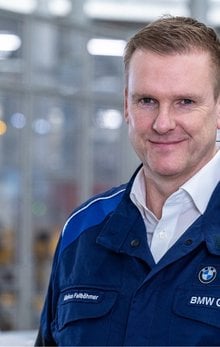
"We use lean, highly intelligent production processes that are already tested in our Bavarian pilot plants," says Dr Markus Fallböhmer, Senior Vice President Battery Production, BMW.
"We profit from short distances. We use digital twins to plan, train and optimise production processes. The ramp-up is a collaboration within the whole production network."
Scaling capacity without defects
For manufacturing leaders, the focus on precision and volume is paramount. The Irlbach-Straßkirchen site aims to produce 1,000 batteries per day at peak capacity. This high-volume output is managed alongside a commitment to the Paris Climate Agreement and net zero goals across the value chain by 2050.
"We produce with the zero defect principle, including continuous inline quality inspection," Markus says. "We use digital twins of production with a comprehensive AI database for process optimisation and employee training."
By streamlining the assembly – specifically by eliminating cell coating and modules – the company reduces complexity while maintaining high standards. Markus adds that for this sixth generation of batteries, "we are adding five new production sites following the local for local principle".
Revolutionary design for Gen-6 battery
The shift to the Gen-6 battery is a radical rethink of battery architecture. By moving away from traditional modules, BMW has created a slimmer, more integrated unit that enhances vehicle dynamics.
"With the new cells comes a completely new concept for the high voltage battery," Markus explains. "No modules, no struts and a more efficient and flat design, and one concept for our whole fully electric portfolio.
“The energy content of the pack is scalable through the rows of cells. The result is a more compact, slimmer and lighter battery with more energy inside."
This "cell-to-pack" approach allows the battery to be integrated directly into the vehicle's cast structure, saving space and improving aerodynamics.

The Gen-6 battery is innovative, using cylindrical cells. "Our battery cells have a diameter of 46 mm and we use it in two different heights. One is 95 mm and the other 120 mm," says Markus.
"Compared to the prismatic cells of the former generation, our new cylindrical cells have a 20% increased energy density."
Digital twin synchronisation
The facility itself was developed using what the company terms "Bavarian speed", aided by advanced digital planning
"We are very proud of what we have achieved since we started in April 2024," says Sabrina Kugler, Overall Project Manager Plant Construction Irlbach-Straßkirchen.
"We not only generate a digital twin already in the planning phase, we also track and synchronise a completed structure with the planning data. Having the final realised structure fed back in the digital twin provides proper service and maintenance during operation."
Circular economy and battery cell recycling
Sustainability at the new plant extends beyond the electric drive, encompassing the entire lifecycle of the battery. BMW identifies the high-voltage battery as the most valuable recyclable component of an EV and the company is researching in-house processes to keep raw materials within the value chain.
"The recycling of high voltage batteries at the end of their lifecycle is also coming more into focus," says Markus. "Therefore, we partner with leading recycling companies. Our partners convert the old batteries into high quality metals that can be reintroduced to battery production."
BMW is also developing a Cell Recycling Competence Centre (CRCC) in Lower Bavaria.
Markus adds: "Thanks to our direct recycling process, residue from battery cell production and entire battery cells can be mechanically broken down into their valuable components."
Company portals

BMW
Executives
Dr. Markus Fallböhmer
Bereichsleiter Produktion Hochvoltspeicher, Energiemodul
Sabrina Kugler
Leitung Industrialisierung Produktion Hochvolt-Speicher Irlbach-Straßkirchen