
BMW: Rolling Out Physical AI in its Car Manufacturing
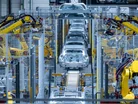
BMW is betting on the long-term future of artificial intelligence, despite ongoing debate about whether the AI bubble will burst. The German automotive firm is incorporating AI into hundreds of areas and predicts that soon every process will be AI-supported.
The company is scaling AI capabilities across development, production and sales operations. It has established a group-wide AI platform that enables custom solutions ranging from process optimisation in manufacturing to generative AI in customer communications.
Marco Gorgmaier, VP Enterprise Platforms and Services, Data, AI, BMW Group, says: "We're scaling artificial intelligence along the value chain, from development and production through to sales. In the foreseeable future, every process at the BMW Group will be AI-supported."
The transformation is driven by business imperatives. "The key drivers behind it all are efficiency, innovation and a clear focus on return on investment (ROI)," he says.
Dr Nicolai Martin, Member of the Board of Management of BMW AG, Purchasing and Supplier Network, says digitalisation and AI have become operational realities. "At the BMW Group Purchasing Division, digitalisation and artificial intelligence are no longer just future topics – they are part of our daily reality," he says.
This strategic approach reflects BMW's commitment to integrating AI throughout its operations. The company recognises that AI adoption is not merely about technology implementation but about fundamentally transforming how work is performed across the organisation.
AI-powered data ecosystems
BMW Group is a driving force behind Catena-X, the first open and collaborative data ecosystem for the automotive industry. The platform enables partners within value chains to address resilience, sustainability goals and regulatory compliance through digital collaboration.
The system allows calculation of product carbon footprints from raw material extraction to final products. Nicolai cites a demonstration project involving the BMW iX kidney grille produced in Landshut, where BMW Group and its partners modelled a complete CO₂ data chain.
The integration of AI with such platforms enables process optimisation, early risk identification and more efficient resource utilisation. These capabilities are being deployed in component production facilities, where AI enhances manufacturing processes and quality inspections.
By leveraging data ecosystems, BMW is creating transparency across its supply chain. This visibility enables the company to make informed decisions about sustainability and operational efficiency whilst meeting increasingly stringent regulatory requirements.
Scaling AI across operations
BMW Group has developed a generative AI self-service platform that provides employees with straightforward access to AI tools.
The BMW Group AI Assistant enables non-technical users to develop their own AI solutions and integrate them into work processes.
Its investment in AI extends to engineering processes, including analysis of specifications documentation and technical standards. In product development, BMW applies AI to technical tasks involving extensive simulations, including crash testing, aerodynamics and autonomous driving scenarios, reducing dependence on physical prototypes.
The company also operates an AI Lab at its Landshut facility. "Here in Landshut, we are already using the power of AI in component production – optimising manufacturing processes and quality inspections with precision and intelligence," says Nicolai.
The democratisation of AI tools across the workforce represents a significant shift in how BMW approaches innovation. By empowering employees at all levels to engage with AI technology, the company is fostering a culture of continuous improvement and digital literacy.

Product development applications
In product development, BMW applies AI to technical tasks involving extensive simulations.
These include crash testing, aerodynamics and autonomous driving scenarios, reducing dependence on physical prototypes and accelerating development cycles.
The company also operates an AI Lab at its Landshut facility.
Nicolai says: “Here in Landshut, we are already using the power of AI in component production – optimising manufacturing processes and quality inspections with precision and intelligence.
“And in our AI Lab, employees have the opportunity to explore cutting-edge AI technologies hands-on, discover their potential, and bring new ideas to life.”
AI tools support vehicle development through simulations that previously required physical testing. This shift enables faster iteration and more comprehensive testing scenarios than traditional methods allowed.
Production transformation
AI implementation supports ongoing transformation of BMW plants into networked digital facilities under the BMW iFACTORY concept. Marco says the company already operates hundreds of use cases in series production.
AIQX is the AI quality platform for constant production line monitoring. Real-time analyses of sensor and image data allow immediate fault detection and elimination, enhancing product quality and reducing defects.
The manufacturer is also researching humanoid robots for autonomously performing complex assembly tasks.
Smart transport systems are being developed to optimise logistics operations further within production facilities.
Company portals

Executives

Nicolai Martin
Board Member Responsible for Purchasing and Supplier Network