Fanatics, PepsiCo & Ball: Manufacturing for the World Cup
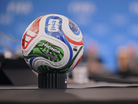
In 2022, the FIFA World Cup in Qatar engaged an estimated five billion people globally. Across just five host cities and eight stadiums, more than 3.4 million people attended matches, driving record global sales for merchandise. Both in stadiums and around the world, the 2026 competition is expected to grab the attention of more fans than ever before.
For the first time, the tournament is spanning three countries simultaneously and features 48 competing nations with matches across 16 cities. Snacks, drinks, shirts and scarves are just some of the items that need to be manufactured, transported and delivered to fans in the right places at the right times. Predicting and meeting demand, particularly on this scale, is no easy feat across the supply chain.

Making the merchandise
Rather than making and stocking millions of shirts branded with teams that are not guaranteed to win games or the hearts of fans, the industry is moving to print-on-demand (POD) and zero-inventory models. Instead of printing 10,000 shirts in China and shipping them to the US, companies are using direct-to-garment (DTG) and direct-to-film (DTF) technology to print items one-by-one in regional facilities exactly when an order is placed.
Often these are made at distributed production hubs, primarily in North America, the UK and South Korea, which are strategically located near major e-commerce fulfilment centres.
To manage manufacturing loads and supply chain stress, brands don't drop all 48 teams' kits at once. Adidas manufactured and released 22 home kits back in November 2025, spreading out the manufacturing volume. Nike, however, held its production runs to release kits in March and April of 2026.
Instead of just mass-producing identical items months in advance, some factories are using AI design tools and 3D modelling to rapidly prototype custom fan merchandise like PVC patches, specialised pins and custom luggage tags. This allows suppliers to pivot production quickly based on viral moments or breakout stars during the tournament.
Feeding stadiums
Because the tournament spans three countries, manufacturers are dealing with three sets of food safety laws: the FDA in the US, the CFIA in Canada and COFEPRIS in Mexico.
Normally, a pallet of beverages or stadium food is tracked using basic barcodes. For the 2026 World Cup, manufacturers are making use of smart labels, QR codes and NFC-enabled packaging. Every pallet and, in some cases, individual sponsor products, act as smart nodes that signal their location, temperature and status in real time.
In a normal supply chain, just-in-time manufacturing is often preferred to keep warehouse costs low. For this tournament, manufacturers are intentionally overproducing and building massive buffer inventories. Planners are using advanced simulation tools like digital twins to predict demand spikes. If an underdog team suddenly advances, demand for products could spike overnight in a specific host city.
US food and beverage companies are heavily leveraging Mexico due to the USMCA trade agreement for regionalised supply chains. Domestically, brands are also leaning on local or regional co-packing facilities to process and package food closer to the end consumer. Brands are also redesigning formulas to use local ingredients and rethinking packaging to reduce reliance on international intermediates.
Real-time retail
Fanatics has been selected by FIFA as the official on-site retail licensee for the 2026 World Cup. The company says this is one of the “largest and most complex retail operations in global sports history”. It will manage in-venue retail operations for 104 matches across 39 days.
“The FIFA World Cup 2026 presents an extraordinary opportunity to delight fans at the world’s biggest sporting event with our unique capabilities,” says Andrew Low Ah Kee, CEO of Fanatics Commerce. “We’re bringing together our expertise across event and physical retail operations, buying and merchandising, product creation and rapid production to serve millions of fans in real time. This is exactly the kind of challenge our team loves – supporting the world's fans through the joy of sport.”
FIFA’s Chief Business Officer Romy Gai says: “This is an incredibly complex undertaking, with 16 host cities across three countries, but Fanatics sets itself apart through an innovative merchandising approach and proven track record delivering standout results at the world’s biggest events.”
Fanatics says it will use its on-demand manufacturing capabilities and global supply chain to produce merchandise that celebrates unpredictable moments that arise during the tournament.
Proximity production
PepsiCo’s Frito-Lay is rolling out a 40 flavour global collection of crisps inspired by countries competing in the tournament. Different regions will get their own lineup, including a collection of three in the US.
Bags of crisps are filled with air to protect the product, making long-haul or cross-boarder shipping both expensive and inefficient. To supply the 16 host cities, PepsiCo has decentralised its World Cup manufacturing. Rather than ramping up production at one central facility, the company is activating a network of regional co-packing facilities and local manufacturing hubs situated within a tight radius of the host stadiums.
This localised production model helps to make sure that factory lines can pivot to high-demand products overnight and deliver them to stadiums without relying on vulnerable, long-haul freight networks.
Custom canning
Both in supermarkets and stadiums, many fans’ drinks of choice will be supplied in cans. Ball Corporation, the world’s largest producer of beverage cans, expects the championship to support demand for its packaging.
In its 2025 Q4 earnings call, CEO Ron Lewis said: “We're really excited about the World Cup. There are going to be an amazing amount of celebrations throughout the summer… I bet it will be slightly positive for all of us that sell beverages.”
In 2022, it launched Ball Digital Printing, a technology that allows for photographic-quality, custom and unique labels to be printed on cans at scale. This technology was used for the last World Cup to produce special labels in support of Brazil for a beer brand.
Did you know?






Executives

Andrew Low Ah Kee
Chief Executive Officer
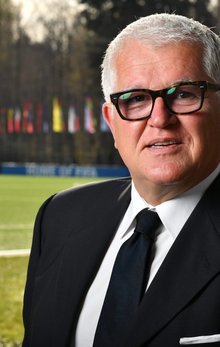
Romy Gai
Chief Business Officer
Ron Lewis
Chief Executive Officer