Transforming Agriculture with Methane Reduction
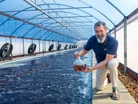
When Steve Meller attended a climate conference in New Zealand six years ago, he did not expect to walk away with a business idea that could transform the manufacturing process in agriculture.
But after hearing a Pacific island Prime Minister describe the challenge of moving communities due to rising sea levels, he was compelled to act.
Steve had already had a long career with Procter & Gamble and an academic background in science.
But this moment led him to channel his skills into solving one of agriculture’s biggest problems – methane emissions from livestock.
Living in California at the time, Steve saw how State Bill 1383 targeted methane reduction from agriculture.
Around the same time, he encountered Australian research on a local seaweed species called Asparagopsis. It turned out that when added to cattle feed, Asparagopsis could cut methane emissions from livestock digestion. It was a breakthrough.
Steve saw an opportunity to make a global impact on agricultural emissions and formed CH4 Global to bring this product to scale.
"Everything I've done in my career has actually led up to what we do now," he says.
CH4 Global and Methane Tamer
Steve used his corporate network and Silicon Valley links to build a team of scientists and executives to develop the product.
CH4 Global’s first major development was Methane Tamer – a commercial livestock feed additive made with Asparagopsis.
Methane Tamer could be mixed into standard cattle feed and studies showed it reduced methane emissions by up to 90 percent.
Steve explains how it worked: "Between 8% and 12% of all the calories a cow consumes is burped out as methane. It's the byproduct of the organisms, the bacteria that live in there, breaking down complex carbohydrates like grains and grasses."
The formulation was not just about seaweed. The challenge was to keep the bioactives stable so they worked consistently.
- Methane is 28 times more potent than CO₂ | Credit: European Commission
- 32% of all human-caused methane emissions come from agriculture | Credit: United Nations Environment Programme
- Whilst estimates differ, it is generally agreed that agriculture contributes to between 8.9% - 19.6% of greenhouse gas emissions globally | Credit: The Breakthrough Institute
Without proper formulation, the active compounds in Asparagopsis broke down quickly. CH4 Global employed experienced formulation experts to stabilise the product.
"Methane Tamer has the ability to deliver on that promise that when farmers use it on day one, it's the same as if they used it on day 180," Steve said.
For farmers, this consistency meant they did not have to change feed practices. The product fitted into existing routines and brought clear economic benefits.
Less methane meant more efficient digestion, so animals needed less feed to grow, improving productivity.
Farmers also stood to benefit from carbon market mechanisms and could receive premium prices for low-methane beef. “Farmers have to make money out of it, simply put," notes Steve.
Taking a climate solution to global scale
In early 2024, CH4 Global opened what it said was the world’s first commercial-scale Asparagopsis production site in South Australia.
It handled the full process – growing, stabilising, formulating and packaging Methane Tamer.

Rather than selling directly to farmers, CH4 Global worked with large companies with broad agricultural supply chains.
Partners included Mitsubishi, UPL, Lotte and Chipotle. These firms helped introduce Methane Tamer across their networks, supported climate commitments and ensured consistent adoption.
"If you want to get to scale and it's ultimately your goal, you have no choice but to start to work with that big end," Steve explained.

Mitsubishi, best known for its automotive and machinery manufacturing, included feed providers and retail firms among its 1,000-plus businesses.
"They did an incredibly deep diligence on every piece of what we do, which for a start-up company is important validation that what you do passes the sniff test many times over with major corporations," Steve says.
With regulatory clearance, CH4 Global planned for Methane Tamer to reach more markets by 2026. The company saw long-term potential to widen access to smaller producers too.
"Once we get past the 2030 timeframe, I can see it being more widely available because it'll be in more wide use, farmers will be more convinced,” Steve adds.
Rethinking livestock and sustainability
Steve is clear about the importance of maintaining food security while improving environmental performance.
"There is a large double-digit percentage of the world that relies on protein sources from ruminants, whether it's cow, sheep, goats, camels and the like for its protein sources, both milk and beef," he explains.
"When you think about the farmers across the world, it's getting close to two billion who are really integrated across that entire ecosystem."
CH4 Global's work addresses what Steve calls the world’s biggest methane source – not fossil fuels, but livestock. If farming practices could cut these emissions without reducing output, it would buy time to shift other parts of the climate equation.
"When you've got ruminants who are clearly large producers of methane – the single largest source on the planet, more than from the oil and gas industry – if you can do something about it, you have the chance to move the needle and buy the world another decade."
Explore the latest edition of Manufacturing Digital and be part of the conversation at our global conference series, Manufacturing LIVE.
Discover all our upcoming events and secure your tickets today.
Manufacturing Digital is a BizClik brand.