Mitsubishi & CH4's Innovative Solution to Farming Emissions
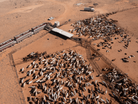
Japanese vehicle manufacturing giant Mitsubishi is swapping motoring for methane reduction in a strategic partnership with Australian manufacturer CH4 Global.
Together, the two companies will work to scale up production and commercial adoption of CH4's Methane Tamer product, an invention aimed at tackling one of agriculture's largest climate challenges: methane emissions from cattle.
The methane problem
According to statistics from the International Energy Agency (IEA) methane emissions contribute to 30% of the current rise in global temperatures.
All in all, methane is one of the single most harmful gases to our atmosphere, with a heat-trapping capacity more than 80 times that of carbon dioxide over a 20-year period.
Now, methane is released into our atmosphere in several different ways, but the primary source of methane on our planet is agricultural emissions, especially flatulence from livestock.
It's tricky: naturally, demand for food grows in step with our rapidly expanding global populations. Therefore, it's difficult to see a way of decarbonising livestock farming unless demand for meat plummets significantly.
While plant-based diets are on the rise in some countries, overall global meat production is always growing, which means that methane emissions are too.
For global governing bodies, tackling this issue is a matter of urgency.
“Cutting methane is the strongest lever we have to slow climate change over the next 25 years and complements necessary efforts to reduce carbon dioxide,” says Inger Anderson, Executive Director at the United Nations' Environmental Program (UNEP).
How Mitsubishi and CH4 Global plan to tackle methane emissions
Methane Tamer is CH4 Global's flagship innovation. The powdered supplement can be mixed into cattle feed and is proven to reduce enteric methane emissions by up to 90%. But what exactly is it?
Health obsessives will be interested to learn that Methane Tamer is essentially a superfood for animals. It is a plant-based substance which uses Asparagopsis seaweed as its foundational ingredient.
“It's a very easy product to use that is dust free, easy to handle, mixes well with feed and cattle like it,” explains Heath Tiller, Principle Operator at HB Rural, a farming company specialising in lamb and beef.
While tests and trials have been hugely successful, the next step for CH4 is to ramp up the manufacturing of the product, so it can be rolled out more easily.
This is where Mitsubishi comes in. According to the agreement, Mitsubishi will help CH4 with its regulatory pathway development in the Japanese market, assist in CH4's feed formulation work in Australia and facilitate feasibility studies for scaled production in South East Asia.
“This partnership with Mitsubishi Corporation marks another significant milestone in our mission to achieve gigaton-scale emissions reductions by 2035,” adds Steve Meller, CEO at CH4 Global.
Targeting the Asia-Pacific region
Mitsubishi and CH4 Global's partnership will initially focus on two key nations: Australia and Japan. In the former, CH4 Global and Mitsubishi will work to expand sales of Methane Tamer, alongside efforts to develop new product formulations.
Meanwhile, in Japan, the collaboration aims to introduce the product to a market of approximately four million cattle, including breeding stock and calves. The market represents a significant opportunity for methane mitigation in livestock farming.
In addition to commercial deployment, both companies are investing in the regulatory approvals necessary to launch Methane Tamer in Japan.
The timeline for the rollout was not disclosed, but immediate efforts will involve feasibility studies and feed formulation adjustments tailored to the needs of the local industry.

How to produce enough of the product
A critical aspect of the partnership is the development of scalable production for Asparagopsis seaweed, the active ingredient in Methane Tamer.
Mitsubishi's extensive experience in aquaculture and agricultural operations across Asia provides a strong foundation for identifying potential production sites in South East Asia.
Through cultivation efforts, the companies aim to meet growing demand while maintaining a sustainable and profitable supply chain.
This emphasis on production is part of CH4 Global's broader EcoPark cultivation system, which integrates environmental sustainability with economic viability. The company's commitment to avoiding subsidies highlights its intention to ensure long-term scalability in the competitive agricultural sector.
Manufacturing climate implications and considerations
For the manufacturing industry, Mitsubishi and CH4's collaboration on Methane Tamer speaks to the ever-growing intersection between environmental stewardship and innovation.
It's simple: addressing methane emissions is not just an environmental imperative but a pressing economic and regulatory issue. Countries such as Australia and Japan are under mounting pressure to meet international climate targets and solutions like Methane Tamer offer a practical path forward.
Mitsubishi's involvement is particularly notable, given its prominence in global supply chains. The partnership leverages Mitsubishi's expertise to explore opportunities for streamlined production and distribution, an essential consideration for scaling a product intended for widespread agricultural use.
“Mitsubishi's deep experience in agricultural products and services and strong presence across Asian markets makes them an ideal partner as we work to expand the reach of our innovative methane reduction solution,” Steve explains.
Scaling solutions for global impact
While the partnership's immediate focus is regional, its ambitions – as CH4 Global's name suggests – are worldwide.
Methane emissions from livestock farming account for a significant share of agricultural greenhouse gases and scalable solutions are necessary to meet the demands of the global food supply chain.
CH4 Global's stated goal of achieving gigaton-scale emissions reductions by 2035 underscores the importance of initiatives like this.
“Humanity's best chance for long-term survival as a species is achieving gigatonne-level CO2-e reductions by 2030. That's what CH4 Global is singularly focused on,” says Steve. “Commercialising, at scale, the only technology platform that can deliver this level of impact.”
Explore the latest edition of Manufacturing Digital and be part of the conversation at our global conference series, Manufacturing LIVE.
Sign up to our weekly newsletter here.
Discover all our upcoming events and secure your tickets today.
Manufacturing Digital is a BizClik brand.