Inside Panasonic's new US Battery Manufacturing Facility
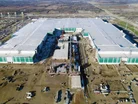
Panasonic has officially launched its new cylindrical lithium-ion battery production facility in De Soto, Kansas.
The factory spans 4.7 million square feet, making it one of the largest gigafactories currently operating in North America. Mass production of 2170 battery cells began on 14 July, and Panasonic targets an annual production capacity of approximately 32 gigawatt hours (GWh).
The Kansas site represents one of the largest single capital investments in the 107-year history of the company.
It also stands as the most substantial economic development project ever undertaken in the State of Kansas. Built on 300 acres — a footprint larger than 225 American football fields — the facility cost $4bn to construct and is projected to support up to 4,000 direct jobs.
A dual-region model for scaled production
The Kansas factory is a cornerstone in Panasonic Energy’s dual-region manufacturing model.
It complements the company's existing Nevada facility, which has been in operation since 2017. That plant currently produces around 41GWh of battery cells per year and employs more than 4,000 workers. It has shipped over 11bn battery cells to date.
With Kansas now in operation, Panasonic's North American production will approach 73GWh annually once full capacity is reached.
The additional volume supports a growing pipeline of demand from electric vehicle (EV) manufacturers, who are increasing capacity to match policy direction and customer demand.
Kazuo Tadanobu, Chief Executive Officer of Panasonic Energy, says: “The opening of our Kansas Factory marks a major milestone in our journey to scale advanced battery production in the United States.
“This achievement would not have been possible without the strong support of our local partners and the State of Kansas. Together, we are accelerating the shift to electrification, reinforcing regional supply chains, and nurturing the next generation of battery talent.”
Productivity gains and cell improvements
The Kansas facility incorporates labour-saving production lines designed to deliver around 20% higher productivity compared to the Nevada site. The company plans to introduce cells with improved materials, targeting a five per cent increase in cell capacity.
Panasonic’s lithium-ion cells have a volumetric energy density of 800 watt-hours per litre (Wh/L). These cells have powered approximately 3.7 million EVs, with around 19bn units shipped globally as of March 2025.
The firm continues to maintain a clean safety record, with no vehicle recalls attributed to its battery products.
Allan Swan, President and Chief Operating Officer of Panasonic Energy North America, places emphasis on operational sustainability.
He says: “We believe that we will continue to succeed if we scale our business in a way that is sustainable for our people, sustainable for our business, sustainable for our industry, and sustainable for our planet.”

Market readiness and regional economic uplift
The De Soto facility enters the market as manufacturers look to ramp up EV output to align with state-level emissions mandates and global regulatory timelines.
While there is no US-wide requirement for phasing out petrol-based vehicles, states such as California have committed to banning internal combustion engine vehicle sales from 2035.
Panasonic is leveraging its 30-year experience in lithium-ion cell manufacturing to position itself as a key supplier for automotive original equipment manufacturers.
Globally, the company produces 70 battery cells every second, which amounts to more than six million cells each day.
Once at full capacity, the Kansas plant’s output could supply batteries for approximately 500,000 EVs annually. The economic benefits of the site extend beyond direct employment.
Panasonic estimates the total employment impact at around 8,000 jobs, factoring in roles across supply chains and service providers.
The company is also investing in long-term academic and industrial collaboration. It has partnered with the University of Kansas to support workforce development and advance battery technology research. Panasonic views this as a route to sustained economic contribution in De Soto and the broader region, while also playing a role in strengthening US-based manufacturing capabilities.
Physically, the scale of the facility is substantial. Three passenger aircraft could be lined up nose-to-tail within the factory’s central area, and walking every square foot would take close to 13 days. The dimensions of the building reflect the scale of Panasonic’s ambition for the region and the EV sector.
Ty Masterson, President of the Kansas Senate, highlights the wider implications: “Politics is the art of the possible, and the grand opening of the Panasonic plant in De Soto ushers in a new era for Kansas — a proud step forward in our mission to bring manufacturing jobs back to America, where they belong.”
Rick Walker, Mayor of De Soto, speaks to the local impact: “As someone who grew up in De Soto, I've spent years driving past this site when the lights were out and the future was uncertain. Seeing it come back to life — with Panasonic Energy as the anchor — is deeply meaningful.
“There’s a new energy in De Soto — not just in batteries, but in the spirit of the community and the momentum we’ve created together. It’s a powerful moment for our city, and one our community can be proud of.”