Renault & Thales: Why are Automakers Turning to Defence?
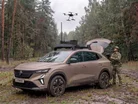
Renault Group and Thales have created 4 TROOP, a prototype hybrid 4x4 multi-role civil vehicle (VCMR) that can function as a mobile command centre.
It has "substantial data processing capabilities", Renault says, and the ability to operate and coordinate unmanned aerial vehicles (UAVs) and unmanned ground vehicles (UGVs).
This comes as other automotive companies look to be moving further into the defence industry.
"With the VCMR, which draws on the extensive range of Renault Group platforms, we are exploring a pragmatic, sovereign approach to operational mobility to quickly address new armed forces requirements and enhance the ability to anticipate developments and take action in the theatre of operations," says Franck Naro, Engineering Vice President - Vehicle Projects & Operations at Renault Group.
"Building on tried-and-trusted civil platforms and our industrial production capacity, we are proposing an agile, resilient capability that can be mobilised immediately."
The 4 TROOP vehicle
While the prototype VCMR is based on the Renault Rafale, the Group says this solution is compatible with several in its range, including SUVs and utility vehicles.
The Rafale E-Tech 4x4 plug-in hybrid setup delivers 300 horsepower and a 22 kWh battery.
It is designed to be a mobile command centre, capable of operating unmanned vehicles and processing data.
Renault says that by combining Thales's advanced technologies with its electronic architectures, it will be possible to series-produce these vehicles for rapid deployment at optimum cost.
The company's after-sales skills for maintenance and vehicle support may also help to reduce logistical needs.
Christophe Salomon, Executive Vice President, Secure Communications and Information Systems at Thales, says: "4 TROOP goes beyond technological enhancements to show how synergy between Thales expertise and onboard digital systems for vehicles can create an innovative and distinctive integrated environment.
"This innovation clears the way forward to a new generation of dual solutions where data acts as a performance enhancer and force multiplier to support domestic security operations as well as high-intensity combat missions."
Automotive and defence in history
Supporting defence is not new to the automotive industry.
During major conflicts like World War II, automakers supported military manufacturing when there was not enough capacity.
Some automakers were originally established for the purpose of defence, including BMW that manufactured aircraft engines and Saab that created military aircraft.
Ford mass-produced B-24 bombers, Volkswagen developed military utility vehicles and companies like Chrysler and General Motors had dedicated defence divisions building tanks and tactical vehicles.
In the latter half of the 20th century, the two industries largely separated.
Defence manufacturing became highly specialised, focusing on bespoke, low-volume, high-survivability platforms that took years to develop.
The automotive sector, however, optimised for high-volume, cost-efficient, mass-market civilian transport.

The finances in 2026
According to CLEPA's Spring 2026 Pulse Check survey, 40% of automotive suppliers are actively reallocating capacity into defence and other non-automotive sectors to mitigate financial pressures.
Approximately 24% of suppliers expect to operate at a loss this year and 76% anticipate profit margins below 5%.
Collapsing domestic sales, intense competition from Chinese manufacturers and the massive capital demands of the EV transition have threatened margins and factory jobs.
Defence, however, is more stable, offering longer-term revenue and more reliable margins.
World military expenditure reached US$2.88tn in 2025, according to the Stockholm International Peace Research Institute. Spending in the US declined, but in Europe it rose by 14%.
Which auto companies are moving to defence?
Before launching the 4 TROOP prototype, Renault Group confirmed to French news channel BFM TV in January it was partnering with Turgis Gaillard to develop military drones with support of the French Government.
Mercedes-Benz Group signed a memorandum of understanding with German startup TYTAN Technologies in June, a company building what it calls “AI-powered counter-drone systems”.
In March, the Financial Times reported that Volkswagen Group is in talks with Israel's Rafael Advanced Defence Systems to switch production from one of its manufacturing sites in Germany from cars to missile defence components.
Some auto suppliers are looking to defence too.
Schaeffler is pursuing the mass production of military drones in partnership with defence AI company Helsing and EV battery maker InoBat has developed NATO-compatible drone batteries capable of charging in under 15 minutes.
Company portals












Executives
Christophe Salomon
Executive Vice-President, Secure Communications & Information Systems
Franck Naro
Vice-président ingénierie du Groupe Renault - Projets Véhicules et Opérations