What Jobs do Robots do in Ford’s Production Lines?
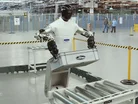
A wheeled humanoid robot has been successfully deployed at Ford’s Innovation Centre in Germany.
Over six weeks, Humanoid’s HMND 01 Alpha robot was tasked with manipulating large, metal car body parts and handling totes.
The AI-powered robot sustained a full hour of uninterrupted operation and achieved 97% reliability in fully autonomous pick-and-place tasks.
The robot was also able to locate thin, sheet-metal body components and move them to a chosen location.
Artem Sokolov, Founder and CEO of Humanoid, says: “Innovation only matters when it works on the factory floor.
“Our joint POC with Ford in Cologne proves that humanoid robots are ready for real industrial tasks — not years from now, but today.
“Our teams moved from discussion to a live on-site demonstration in six weeks, and the results exceeded every benchmark.
“The POC showed that rapid progress is possible when both sides align on scope and maintain commitment to safety.”

Autonomous robots and self-driving vehicles
This humanoid robot is not Ford’s first venture into the field of robotics.
In 2019, Ford partnered with Agility Robotics to explore self-driving vehicles for delivery and robots that can carry deliveries from car to front door.
Digit is a two-legged robot designed and built by Agility to walk like a human and lift packages weighing up to 40 pounds.
Keeping the robot lightweight is a challenge when it needs lots of information, so the companies looked into sharing detailed maps created by self-driving vehicles with Digit.
If the robot were to encounter an unexpected obstacle, it could send an image back to the vehicle where a solution can be configured.
Cobots in Ford factories
Collaborative robots, known as cobots, have been integrated across Ford’s assembly lines to work directly alongside humans.
At its Cologne plant in Germany, cobots were installed in 2019 to sand the body surface of Ford Fiestas.
The six UR10 cobots, created by Universal Robots, can sand the entire body in just 35 seconds.
Final checks are completed by two employees before the vehicle body continues along the line.
Ford and Boston Dynamics
In 2020, Ford deployed Boston Dynamics’ four-legged robots, named Fluffy and Spot, to scout hard-to-reach areas in its Van Dyke Transmission Plant.
“We design and build the plant. After that, over the years, changes are made that rarely get documented,” explained Mark Goderis, Ford’s Digital Engineering Manager.
“By having the robots scan our facility, we can see what it actually looks like now and build a new engineering model.
“That digital model is then used when we need to retool the plant for new products.”
Without the robots, scanning one plant could take weeks.
Wearable robotics to reduce strain
In partnership with Ekso Bionics, Ford rolled out upper body exoskeletal technology in 2019.
The EksoVest can help to reduce injury risk when carrying out repetitive overhead tasks.
It provides lift assistance of up to 15 pounds per arm and supports a worker’s body during tasks like reaching up to screw in bolts.
The vest was piloted at Fords’ Michigan Assembly Plant before expanding to 15 plants in seven countries around the world.
The Ford Robotics Building
In 2021, the Ford Robotics Building was opened at the University of Michigan.
This US$75m complex holds custom research labs for robotics alongside classrooms and offices.
For Ford, the facility supports modernised research and product development processes, such as the testing of Digit robots and Spot.
The building is also home to the Aaron Friedman Marine Hydrodynamics Lab and the Space Physics Research Lab.
Company portals







Executives
Artem Sokolov
Founder
Mark Goderis
Area Manager Cell Assembly BlueOval SK Battery