
Top 10: Electric Sports Cars

The move to electric vehicles challenges automotive engineering. Traditional performance metrics are being recalibrated by instant torque and advanced drivetrains. The transition is about reimagining vehicle architecture and character, not just swapping power sources.
Leading electric models offer a glimpse into this new landscape. They show how manufacturers use clean drivetrains and efficient battery tech to push performance boundaries.
Examining these vehicles, from accessible hatchbacks to exclusive hypercars, reveals the strategies shaping the sector. The future of high-performance automotive manufacturing is electric.
10. MG4 XPower
CEO: Xinyu Liu
HQ: Shanghai, China
Year launched: 2023 (XPower variant)
Notable feature: Dual‑motor “hyper‑hatch” all‑wheel‑drive performance at an accessible price
Price: From ~US$42,000
The MG4 XPower is a manufacturing milestone, putting a dual-motor, all-wheel-drive system in an accessible hatchback.
This model shows how high-performance EV technology can be democratised.
It challenges established brands to deliver engaging performance without a premium price, raising questions about production efficiency.
9. Alpine A290
CEO: Philippe Krief
HQ: Dieppe / Boulogne‑Billancourt, France
Year launched: 2025
Notable feature: Lightweight, driver‑centric hot‑hatch EV philosophy
Price: From ~US$41,000
Alpine’s A290 focuses on lightweight construction and dynamic handling over raw power. This approach uses specialised engineering to create a driver-focused experience.
It offers a way to stand out in a market where straight-line speed is common.
The A290 proves that chassis tuning and component choice can define a car’s character.
8. Audi RS e‑tron GT
CEO: Gernot Döllner
HQ: Ingolstadt, Germany
Year launched: 2021
Notable feature: Grand‑touring luxury with supercar‑rivalling pace
Price: From around US$145,000
The Audi RS e-tron GT exemplifies strategic platform sharing, using hardware developed with Porsche.
It shows how luxury brands can achieve economies of scale while keeping separate identities.
It blends grand touring refinement with supercar acceleration. This mix of shared components and unique tuning could be a blueprint for other premium automotive groups.
7. Tesla Roadster (second generation)
CEO: Elon Musk
HQ: Austin, Texas, USA
Year launched: Announced 2017, expected 2026
Notable feature: Headline‑grabbing sub‑2‑second 0–60mph claims and extreme range targets
Price: From ~US$200,000
Despite delays, the second-gen Tesla Roadster is a powerful strategic tool.
Its ambitious performance and range claims act as industry benchmarks, pushing competitors to innovate faster.
The Roadster is a case study in using announcements to shape market perception. It establishes extreme performance as a brand pillar long before delivery.
6. Hyundai Ioniq 5 N
CEO: José Muñoz
HQ: Seoul, South Korea
Year launched: 2024
Notable feature: Playful software‑driven “ICE‑like” sound and shift simulation layered onto serious chassis tuning
Price: From ~US$75,000
The Hyundai Ioniq 5 N shows how software can engineer a car’s character.
By simulating gearshifts and engine sounds, Hyundai adds sensory feedback often missing in EVs.
This represents a new frontier where software helps create the user experience. It proves manufacturers can use code to differentiate their products and build a distinct brand feel.
5. Nissan Ariya Nismo
CEO: Ivan Espinosa
HQ: Yokohama, Japan
Year launched: 2024
Notable feature: Nismo‑tuned dual‑motor powertrain and aero package in a practical crossover body
Price: From ~US$50,000
With the Ariya Nismo, Nissan applies its Nismo performance brand to an electric crossover. The strategy is to transfer brand equity and a performance legacy into the electric era.
This move highlights the importance of heritage for customer loyalty during the EV transition. It fuses crossover practicality with enhanced dynamics, testing the market for performance family vehicles.
4. Lotus Eletre R
CEO: Feng Qingfeng (Lotus Group)
HQ: Hethel, Norfolk, UK (engineering) with global operations in Wuhan, China
Year launched: 2023
Notable feature: Active aerodynamics and advanced chassis tech delivering supercar‑level thrust in an electric SUV
Price: From ~US$150,000
The Lotus Eletre R delivers the brand’s signature handling in a large SUV. This is achieved through advanced aerodynamics and sophisticated chassis systems, showing a mastery of vehicle dynamics.
For manufacturers, the Eletre R is a lesson in preserving brand identity when entering new segments. It proves software and hardware can overcome the limits of vehicle size and weight.
3. Tesla Model S Plaid
CEO: Elon Musk
HQ: Austin, Texas, US
Year launched: 2021 (Plaid version)
Notable feature: Tri‑motor all‑wheel‑drive layout delivering four‑figure horsepower and brutal acceleration
Price: From ~US$90,000
The Model S Plaid redefines production capabilities with its 1,000-plus horsepower tri-motor powertrain. It sets a new standard for scalable, extreme performance.
Producing a family saloon with hypercar-beating acceleration in volume has forced competitors to rethink their strategies. It highlights the disruptive potential of vertically integrated EV manufacturing.
2. Porsche Taycan Turbo GT
CEO: Oliver Blume (Porsche AG)
HQ: Stuttgart, Germany
Year launched: 2024
Notable feature: Track‑honed GT package with extreme performance and circuit‑ready cooling and chassis hardware
Price: From around US$260,000
The Porsche Taycan Turbo GT proves that EVs can deliver sustained, track-level performance. It prioritises consistent power delivery, advanced cooling and precise chassis feedback.
The result is an EV that feels at home on a track, offering repeatable performance instead of short bursts of speed. It shows electric sports cars can deliver endurance and nuance alongside ferocious pace.
1. Rimac Nevera
CEO: Mate Rimac
HQ: Sveta Nedelja, Croatia
Year launched: 2021
Notable feature: Quad‑motor torque‑vectoring hypercar platform with around 1,900hp and ultra‑low production run
Price: Around US$2.1m
The Rimac Nevera sits at the apex of EV technology, acting as a laboratory for the industry. Its quad-motor powertrain and advanced torque-vectoring offer control beyond traditional mechanical systems.
Though its price and production are exclusive, its true value is in technology transfer.
Major manufacturers partner with Rimac, making the Nevera a catalyst for innovation in more accessible EVs.







Executives

Elon Musk
Tesla CEO

Gernot Döllner
CEO

Ivan Espinosa
CEO

José Muñoz
CEO
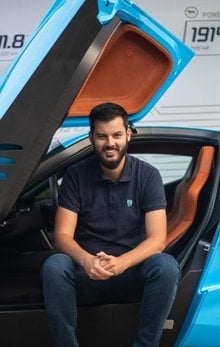
Mate Rimac
CEO

Oliver Blume
CEO

Philippe Krief
CEO

Qingfeng Feng
Director & CEO

Xinyu Liu
CEO