
HII & GrayMatter Robotics: Physical AI in US Shipbuilding
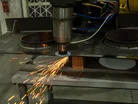
Huntington Ingalls Industries (HII), the largest shipbuilder in the US, has signed a memorandum of understanding with GrayMatter Robotics to integrate physical AI into its manned and unmanned shipbuilding operations.
Adding physical AI to HII’s shipbuilding capabilities will bring autonomous surface preparation, coating and inspection technologies into its operations.
Compared with Asia, the US has been slow to integrate robotics into its manufacturing processes according to the International Federation of Robotics.
Asia is also the leader in ship manufacturing companies, with the majority of the world's largest ship manufacturing companies being based in China, South Korea and Japan.

The partnership between GrayMatter and HII
HII is the largest producer of unmanned underwater vehicles for the US Navy and the world.
In a company statement, HII said that the integration of the Los Angeles based robotics engineering company’s physical AI into its shipbuilding operations could “accelerate throughput”, “strengthen the maritime industrial base” and “augment the shipbuilding workforce”.
The companies will work to identify and potentially pursue opportunities in four areas: autonomous shipbuilding capability development, integration of GMR technologies with other shipbuilding technology initiatives, workforce training to extend automation as well as the acceleration and scaling of unmanned system production.
Eric Chewning, HII’s Executive Vice President of Maritime Systems and Corporate Strategy, says: “We are in the midst of an American shipbuilding renaissance and we are extremely excited to partner with GrayMatter Robotics to explore incorporating their state-of-the-art physical AI models into our shipbuilding operations.
“Our shipbuilding throughput was up 14% in 2025 and we are looking for an additional 15% increase in 2026. By working with new partners like GMR we can further augment our workforce and speed up US Navy shipbuilding production.”
AI driven technology in shipbuilding
While welding automation and other AI technologies continue to advance, much of the work of HII’ shipbuilding remains hands-on and highly skilled, with tasks such as sandblasting, grinding and coating following strict adherence to requirements.
HII says that AI‑driven technologies offer promising opportunities to support these critical processes by reducing repetitive work and improving consistency to help accelerate delivery timelines and meet the US Navy’s growing demand.
Ariyan Kabir, GrayMatter Robotics CEO and Co-Founder, says: “GrayMatter Robotics is proud to be leading the charge to bring Factory SuperIntelligence to bolster our national security in this partnership with HII.
“We are partnering with HII to solve difficult problems. We will push to drive down delivery time, build our arsenal, build the essential components for our war fighters, and we have to do this very, very quickly.”
Geopolitical ramifications
According to McKinsey, geopolitical tensions and potential shifts in the balance of seafaring power, as well as emerging technologies that are expected to enable new types of military vessels, could all encourage the US, as well as other countries around the world, to consider reinforcing domestic shipyards’ capacities and capabilities.
The US seeks to scale its own shipbuilding operations to compete with China. A 2025 Executive Order titled “RESTORING AMERICA'S MARITIME DOMINANCE” said: “Recent data shows that the United States constructs less than 1% of commercial ships globally, while the People's Republic of China is responsible for producing approximately half."
US President Donald Trump’s Executive Order added: “Rectifying these issues requires a comprehensive approach that includes securing consistent, predictable and durable Federal funding, making US flagged and built vessels commercially competitive in international commerce.”
The shipbuilding industry remains largely centred in Asia, with China, Japan and South Korea leading in manufacturing high-tech vessels with companies like China State Shipbuilding Corporation, Hyundai Heavy Industries and Hanwha Ocean dominating the global ship manufacturing industry.
Manufacturing leaders won’t want to miss Sustainability LIVE: The US Summit, taking place at Navy Pier, Chicago, on April 21–22.
Co-located with Procurement & Supply Chain LIVE, the event unites senior decision-makers at a time when supply chains, sustainability and business performance are more interdependent than ever.
Secure your place now for The US Summit – group booking discounts available.
AI and robotics in manufacturing
Compared to other industries, the adoption of AI has been slow in manufacturing, with one third of respondents in a McKinsey survey of manufacturing COOs saying that their companies spent less than 1% of the cost of goods sold on digital and AI.
The survey from McKinsey found that levels were not predicted to stay that low, with 93% of respondents saying they will spend more. Almost one third intend to spend at least 5% on digital and AI.
In robotics integration in manufacturing, China leads the way, representing 54% of global deployments in International Federation of Robotics (IFR) statistics from 2024. The IFR statistics show that 295,000 industrial robots have been installed in the country, which was the highest annual on record when the statistics were published.
By comparison, the IFR data from 2024 found that the US installations of robots were at 34,200, leaving a significant gap in deployments of the technology between the two competing superpowers.
The IFR suggested that while there are numerous US based robot system integrators implementing robotic automation solutions, the US imports most of its robots from Japan and Europe, with few domestic suppliers.