Mercedes-Benz's Robot Apollo: Revolutionising Automotive
Mercedes-Benz continues to transform its production network.
Critical to this process is its Berlin-Marienfelde facility- a leading centre for innovation - especially when it comes to MO360 digital production technologies.
The factory is spearheading advancements including the manufacturing of high-performance electric axial-flux motors through innovative production techniques, powered by AI and humanoid industrial robots.
Berlin-Marienfelde was first established as a global centre for digitalising production in 2022, with the creation of the Mercedes-Benz Digital Factory Campus (MBDFC).
This campus fosters the development of future software applications in an authentic production setting, providing a crucial testing ground for digitalisation innovations.

At its core lies the MO360 digital production ecosystem, which integrates all essential software applications and data across the global production network.
The MBDFC enables new processes and technologies to be developed, tested and swiftly implemented within Mercedes-Benz’s worldwide manufacturing operations.
This includes processes intimately linked to Mercedes-Benz Operating System (MB.OS).
So far AI-powered tools like the manufacturer's Digital Factory Chatbot Ecosystem and MO360LLM Suite have been utilised to enhance Mercedes-Benz's MO360 production system.
Marienfelde also played a key role in preparing the Rastatt factory for the ramp-up of the new Mercedes-Benz CLA, the first vehicle featuring MB.OS.
Another critical innovation being explored and tested in the facility is humanoid robots.
At the facility these robots, supplied by US based manufacturer Apptronik, are reinforcing the site's global leadership in production innovation.
Berlin-Marienfelde: bringing Apollo to production
Demonstrating its confidence in robotic solutions, Mercedes-Benz is investing millions into Apptronik, a company that emerged from the Human Centered Robotics Lab at the University of Texas at Austin.
The brand has been using industrial robotics since the 1970s to automate monotonous and physically strenuous labour tasks.
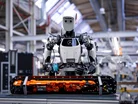
Mercedes-Benz has adopted Apptronik's Apollo robot, one of the world's most advanced commercial humanoid robots, to support repetitive processes in intralogistics.
Apollo is being tested for tasks such as transporting components or modules to the production line, assisting highly skilled workers and carrying out initial quality inspections.
Apollo robots are collecting data in real production environments to refine their capabilities within MO360.
"Humanoid robots are no longer just a popular theme in sci-fi movies – they have become reality," wrote Ola Kaellenius, CEO of Mercedes-Benz on LinkedIn.
"Everyone, meet Apollo, the advanced humanoid.
"He is now an indispensable part of our effort to solidify the position of our Mercedes-Benz Digital Factory Campus, our global centre of competence for the digitalisation of production."
"Since the 1970s, industrial robotics have been supporting with monotonous and physically demanding tasks.
"Fast forward to 2025 and Apollo is in the testing phase of becoming a reliable assistant for tasks like logistics, assembly and quality checks.
"We're investing in Apollo’s creator Apptronik, who recently partnered with Google DeepMind, to further explore the integration of robots at our facilities."
The use of humanoid robots enables Mercedes-Benz to deploy robots optimised to perform in spaces made for humans, avoiding the need for full-scale facility redesigns.
Through teleoperation and augmented reality, Mercedes-Benz employees are transferring their expertise to Apollo, enabling the robot to learn from real-world manufacturing professionals.
At the Digital Factory Campus this should evolve into Apollo robots performing fully autonomous operations, enabling the creation of a comprehensive, intelligent and flexible robotic assistance system.
In December, Apptronik also announced a strategic partnership with Google DeepMind’s robotics team to enhance humanoid robots with state-of-the-art artificial intelligence, further boosting their potential in dynamic environments.
“Mercedes plans to use robotics and Apollo for automating some low skill, physically challenging, manual labour – a model use case which we’ll see other organisations replicate in the months and years to come," says Jeff Cardenas, co-founder & CEO of Apollo.
How AI is assisting engineers
Industrial AI is reshaping the automotive industry and at the MBDFC Mercedes-Benz is at the forefront of developing and deploying it.
We previously discussed Mercedez-Benz's in-house Digital Factory Chatbot Ecosystem which allows workers to query production databases through simple chat commands.
Whether asking about machine maintenance or seeking best-practice manufacturing methods, employees receive instant, precise answers in multiple languages.
Also mentioned was the manufacturer's MO360 AI Factory, which ensures that AI is seamlessly integrated into everyday production processes to enhance its accessibility and practicality for workers. making it accessible and practical for all employees.
But another critical AI innovation at the facility is its virtual multi-agent system, where AI-driven assistants analyse complex data in real time.
These virtual agents swiftly identify the root causes of quality deviations, eliminating the need for time-consuming manual investigations.
Engineers can now rely on AI-powered analysis to detect anomalies, identify patterns and suggest solutions at the touch of a button, significantly boosting manufacturing efficiency and precision.
Marienfelde & axial-flux motor technology
In addition to its status as a pioneering site for production digitalisation, the Berlin-Marienfelde site also maintains a vital role in Mercedes-Benz’s global powertrain production network.
As the automotive industry transitions towards an all-electric future, the factory is set to become a centre of excellence for high-tech electric motor manufacturing.
From 2026, Marienfelde will commence production of the state-of-the-art axial-flux motor, a crucial advancement in electric mobility.
Manufacturing an axial-flux motor involves approximately 100 production processes, with around 65 being entirely new to Mercedes-Benz and 35 being industry-first innovations.
Novel laser technologies, advanced bonding processes and AI-driven quality control systems are among the cutting-edge techniques being introduced.
Many of these developments have been pioneered in-house, resulting in over 30 patent filings, reinforcing Marienfelde’s status as a global leader in production innovation.
By integrating humanoid robots, AI and ground breaking production techniques, Mercedes-Benz is redefining automotive manufacturing, ensuring that its factories remain at the forefront of technological excellence in the era of electric mobility.
"Established in 2022 at our Berlin-Marienfelde location, the Campus combines development, testing and rapid implementation of pioneering software applications for our global production network – in a real production environment," Ola Kaellenius, CEO of Mercedes-Benz added on LinkedIn.
"The transformation of Berlin-Marienfelde, our oldest production site in the network, is ongoing.
"Besides digitalisation, we’re establishing it as the centre of excellence for the manufacturing of high-performance electric motors.
"Starting next year, the cutting-edge axial-flux motors – a collaborative development project by Mercedes-AMG GmbH and YASA – for our future AMG.EA models will exclusively roll off the production line at the plant.
"So, I guess Berlin is not only at the forefront when it comes to nightlife, culture and creation but also innovation and practical AI applications."
"To build the most desirable cars we continually evolve the future of automotive production: Advancements in robotics and AI open up new opportunities also for us," adds Jörg Burzer, Member of the Board of Management of Mercedes-Benz Group AG, Production, Quality & Supply Chain Management.
"We are exploring new possibilities with the use of robotics to support our skilled workforce in manufacturing.
"This is a new frontier and we want to understand the potential both for robotics and automotive manufacturing to fill labour gaps in areas such as low skill, repetitive and physically demanding work and to free up our highly skilled team members on the line to build the world’s most desirable cars."
Explore the latest edition of Manufacturing Digital and be part of the conversation at our global conference series, Manufacturing LIVE.
Sign up to our weekly newsletter here.
Discover all our upcoming events and secure your tickets today.
Manufacturing Digital is a BizClik brand.