Samsung & Nvidia: A Bold Vision for AI Megafactories
Samsung Electronics is set to launch of an AI Megafactory through a collaboration with Nvidia, embedding AI across its worldwide manufacturing network for semiconductors, mobile devices and robotics.
The initiative brings together more than 50,000 Nvidia graphics processing units (GPUs) to support AI operations across all stages of production. These GPUs process large volumes of data generated from manufacturing systems, enabling real-time analytics, prediction and optimisation across the entire production chain.
The AI Factory will connects every stage of semiconductor manufacturing – from design to operations – into one unified intelligent framework. It will integrate systems across process management, equipment performance and quality assurance, aiming to create a continuously self-optimising environment with minimal human intervention.
Bringing AI to semiconductor design and production
Samsung and Nvidia are expanding their long-standing partnership, which began 25 years ago when the former provided DRAM for the latter's early graphics cards.
The companies now collaborate on high-bandwidth memory (HBM) and advanced foundry services, including work on the HBM4 platform, which uses Samsung’s sixth-generation 10-nanometre-class DRAM and a 4nm logic base die, achieves processing speeds of up to 11 gigabits per second. This exceeds the JEDEC (Joint Electron Device Engineering Council) standard of 8Gbps. The platform supports AI manufacturing by increasing data throughput and enabling faster decision-making across connected systems.
As part of its product roadmap, Samsung continues to develop next-generation memory solutions such as HBM, GDDR (graphics double data rate) and SOCAMM (system-on-chip attached memory modules). These technologies aim to boost the efficiency and scalability of AI operations across its production facilities.
Samsung also uses Nvidia’s cuLitho and CUDA-X software libraries for its optical proximity correction (OPC) processes. OPC is used in chip manufacturing to improve the precision of patterns printed on silicon wafers. Through this integration, Samsung achieves a 20-fold increase in computational lithography performance. AI supports this process by predicting and correcting for circuit pattern variations, shortening development cycles and enhancing manufacturing accuracy.
Using digital twins to streamline operations
To scale its AI Factory model, Samsung is set to build digital twins of its manufacturing facilities using Nvidia Omniverse libraries.
A digital twin is a virtual replica of a physical environment that mirrors its systems, workflows and machinery. These simulations allow Samsung to perform predictive maintenance, anomaly detection and operational planning before changes are made on the production floor.
The approach supports a data-centric model, where AI continuously learns from factory inputs and adjusts performance in real time.
Samsung plans to extend this framework to its manufacturing hub in Taylor, Texas, and other international sites. It will connect production systems across its memory, logic, foundry and advanced packaging divisions through Nvidia’s accelerated computing platform.
The collaboration also includes work with electronic design automation (EDA) partners to create GPU-accelerated design tools. These tools enable Samsung to simulate and optimise semiconductor layouts more efficiently within the digital twin environment.
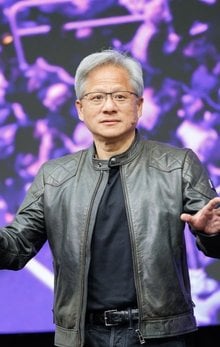
Jensen Huang, Founder and CEO at Nvidia, describes the collaboration as a turning point in industrial development: “We are at the dawn of the AI industrial revolution – a new era that will redefine how the world designs, builds and manufactures.”

Integrating AI in robotics and mobile networks
Beyond chip production, Samsung uses Nvidia technology in robotics and generative AI systems.
The company trains its proprietary AI models on Nvidia accelerated computing and the Megatron framework, which supports advanced reasoning functions such as real-time translation, multilingual communication and intelligent content summarisation. These models now power more than 400 million Samsung devices.
In robotics, Samsung deploys the Nvidia RTX PRO 6000 Blackwell Server Edition to support factory automation and humanoid systems. The platform combines AI-based reasoning with real-time simulation, allowing robots to understand their environment, execute tasks and make decisions autonomously.
Samsung also uses Nvidia Jetson Thor for AI processing in robotics. The system enables robots to respond to environmental changes in real time, supporting operational safety and productivity. These capabilities are being integrated into the AI Factory infrastructure, with plans to expand across Samsung’s global production operations.
Samsung and Nvidia are also working on integrating AI with radio access networks (AI-RAN). The project involves Korean telecoms providers, universities and research institutions, with a focus on developing networks that support AI-powered devices at the edge of the network – closer to where data is generated.
Edge AI allows machines such as robots, drones and industrial equipment to process information locally, reducing the need for remote data transmission. This enables real-time responsiveness in areas like connected manufacturing and mobile automation.
The approach follows a proof-of-concept by Samsung and Nvidia in 2024, where software-based mobile networks were combined with GPU acceleration to test AI-RAN capabilities.
A Samsung spokesperson confirms that these developments form part of a wider push to expand intelligent infrastructure: “Our long-term collaboration with Nvidia allows us to create a more intelligent manufacturing foundation while advancing technologies that connect industries and consumers through AI."


Executives
Jensen Huang
Founder and CEO