
The Industrial Robot Manufacturers Boosting Factory Output
More than 542,000 industrial robots were installed in 2024 according to the International Federation of Robotics.
Three-quarters of these were in Asia, 16% in Europe and 9% in the Americas.
In 2026, the OECD and the IMF expect global growth at 3.1%.
Takayuki Ito, President of the International Federation of Robotics, explains: “The transition of many industries into the digital and automated age has been marked by a huge surge in demand.”
Executing complex robotics deployments demands the software interoperability and massive global supply chains that only enterprise-level robotics vendors have.
The business case for industrial robots
Deloitte’s 2025 Smart Manufacturing Survey says that 48% of manufacturers face moderate to significant challenges in filling production and operations roles.
Advanced robotics and AI-powered automation are the primary levers being pulled to decouple production volume from labour availability.
The survey also shows that manufacturers implementing smart manufacturing technologies report a 10% to 20% improvement in production output.
By offloading repetitive or physically dangerous tasks, gains in existing employee productivity can also be achieved.
Automating physical workflows and integrating them with MES is unlocking up to 15% in capacity.
The total cost of ownership for industrial robots is falling as sensors get cheaper, integration protocols are standardised and Robotics-as-a-Service grows.
Top industrial robot manufacturers
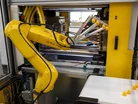
FANUC began as a special project team within Fujitsu in 1955 and was established as an independent company in 1972.
Famous for its bright yellow robots, its portfolio is one of the widest, ranging from high-precision cobots to heavy-duty industrial models.
Major manufacturer ABB is selling its Robotics division outright to SoftBank Group, including its industrial robots, AMRs and AI and software platforms.
The Machine Automation segment is remaining with ABB and being absorbed into its Process Automation business area.
UBTECH aims to address labour shortages and rising costs in manufacturing by creating robots that can operate in environments designed for humans.
Its Walker S2 model is able to autonomously swap its own battery, minimising downtime in 24/7 operations.

Yaskawa Electric coined the term Mechatronics in 1969 and has built its identity on the synchronisation of servos and robots.
Its robot brand, MOTOMAN, is used in arc welding, assembly and semiconductor wafer handling.
Teradyne owns Universal Robots and Mobile Industrial Robots, top providers of cobots and AMRs.
Many of its robots are designed for low-code or no-code operation.
Industrial robotics across the world
China alone deployed 54% of industrial robots in 2024, with its operational robot stock passing two million.
The country’s market share also climbed to 57%, an increase from around 28% over the last decade.
Japan remained the second-largest market for industrial robots and Korea installed 30,600 units.
India’s adoption of industrial robots grew 7% and its automotive industry was the strongest driver.
In Europe, installations fell by 8% to 85,000 in 2024 and Germany was the largest robot market.
The UK saw installations decrease by 35% with the end of a tax credit programme.
In the US, robot installations decreased 9% and most were imported from Japan and Europe.
Mexico and Canada also saw declines, with the automotive industry remaining these countries’ key customer for robots.






Executives

Takayuki Ito
President