Robots, Workforce & ESG: This Week's Top Manufacturing News

2 March
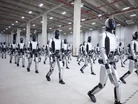
More than 542,000 industrial robots were installed in 2024 according to the International Federation of Robotics.
Three-quarters of these were in Asia, 16% in Europe and 9% in the Americas.
In 2026, the OECD and the IMF expect global growth at 3.1%.
Takayuki Ito, President of the International Federation of Robotics, explains: “The transition of many industries into the digital and automated age has been marked by a huge surge in demand.”
3 March
Change is happening in manufacturing. AI, IoT and other tools are reshaping production lines and the jobs of people running them.
At JLR, electric vehicles have brought about a variety of changes and opportunities to streamline production. Claire Parker, the company’s Global Head of DE&I, believes that a diverse workforce brings a broader range of problem-solving approaches that can tackle these changes head-on.
Claire shares her expertise with Manufacturing Digital.
See the full story in the March 2026 edition of Manufacturing Digital.
4 March
Suntory Beverage & Food (SBF) Great Britain and Ireland has announced a £25m (US$33m) investment to install a new high-speed manufacturing line at its facility in Coleford, Gloucestershire.
The project, officially named Apollo 5, serves as the centerpiece of a broader £57m (US$76m) supply chain transformation programme at the site, which celebrates its 80th anniversary this year.
This capital injection is designed to modernise the facility's infrastructure, ensuring it remains a primary hub for the production of Lucozade and Ribena.
The new production line, which uses aseptic technology – a more sustainable way of cleaning and filling bottles – is engineered to consolidate the manufacturing of these iconic brands into a single, streamlined system.
4 March
AI has generated more cost savings in manufacturing than in any other industry, according to McKinsey. Working in tandem with advanced technologies, including robotics and IoT, many processes in smart factories can now run themselves with minimal human intervention.
Facilities are building on smart factory foundations to become cognitive networks, integrating hybrid human-AI workforces and ecosystems of intelligent agents.
Smart factories have four core ingredients:
- industrial IoT (IIoT)
- big data and analytics
- digital twins
- robotics.
When these come together, maintenance becomes predictive, agility increases and efficiency can soar.
See the full story in the March 2026 edition of Manufacturing Digital.
6 March
The escalation of military conflict between the United States, Israel and Iran has triggered an immediate crisis across global supply chains.
The effective closure of the Strait of Hormuz is disrupting maritime trade and air cargo supplying operations worldwide.
This development could have significant implications for manufacturers reliant on just-in-time delivery systems and raw material imports from the region.
"The speed and scope of escalation in the Middle East will have taken many businesses by surprise and has highlighted just how unstable the region can become in as little as 48 hours," says Simon Geale, Executive Vice President at Proxima.
Company portals







Executives
Claire Parker
Global Head of Diversity Equity and Inclusion
Simon Geale

Takayuki Ito
President